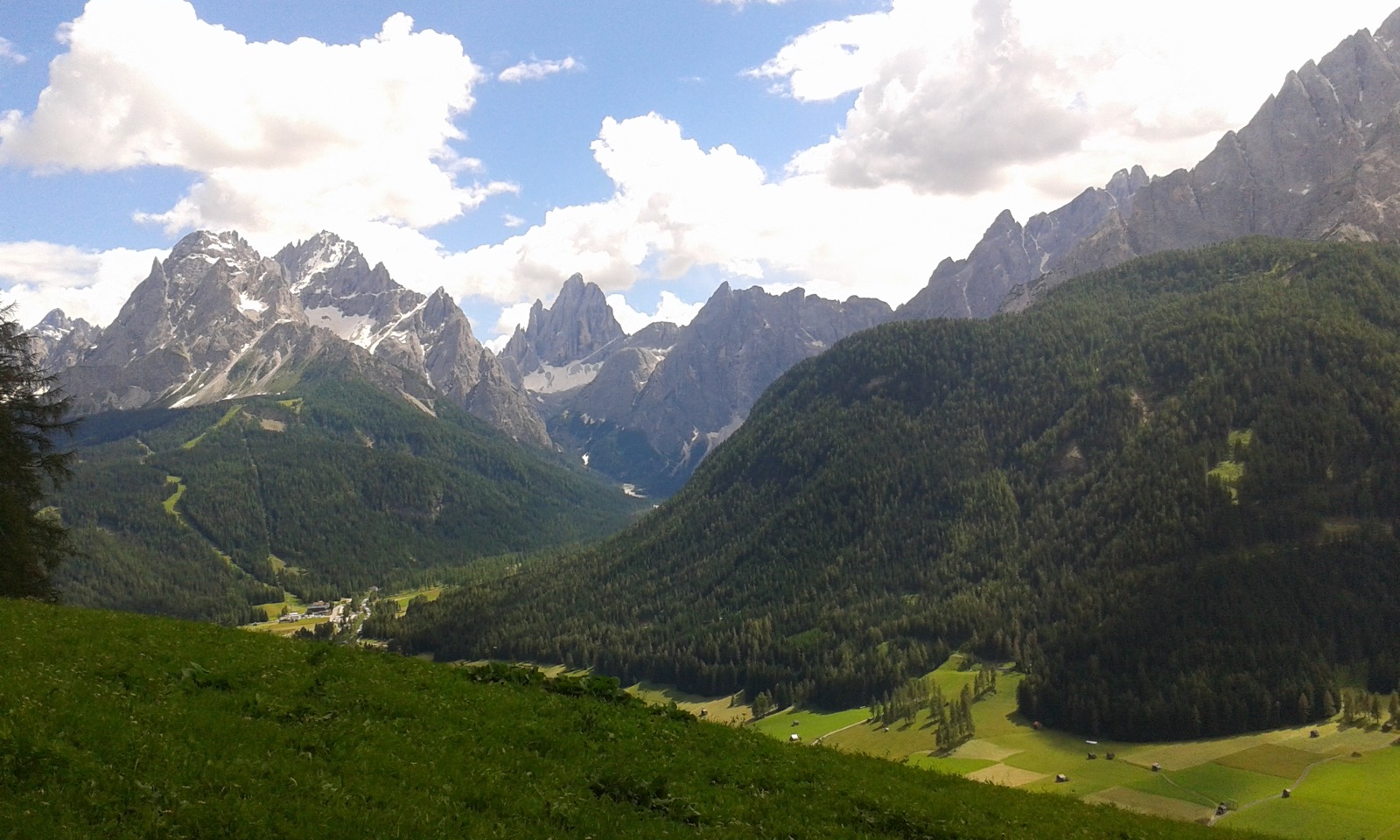
Five peaks south of Sesto carry the name of an hour: Nine is the Pala di Popera (2,582 m), Ten the Croda Rossa di Sesto (2,965 m), Eleven the Cima Undici (3,092 m), Twelve the Croda dei Toni (3,094 m) and One the Cima Una (2,698 m). The original names are German, Neuner, Zehner, Elfer, Zwölfer and Einser, because Sesto is a German-speaking village. From the valley floor the sun passes over the peaks in that order, and the one it stands over gives the solar time. Some sources add an Eight, the Croda Sora i Colesei.
The accuracy is not what the stories say. We calculated the sun's position against the peaks' coordinates: from the road between the Haus der Berge and Moso, the spot the tourist office points to, Twelve marks true noon to within three minutes in every season, while Nine and Ten run about an hour late in winter. The hour-by-hour calculation is in the guide The Sesto sundial, calculated.
Look in winter, between mid-morning and one o'clock, when the sun is low and passes just above the ridges. The South Tyrolean side of the peaks lies in the Tre Cime nature park, part of the Dolomites UNESCO World Heritage Site, and to see them up close without climbing there is the Val Fiscalina.
The right hours for the light at Meridiana delle Dolomiti di Sesto and at the other spots worth the early start: Where to see sunrise and sunset in the Dolomites (and the enrosadira).
Frequently asked questions
How do you read the Sesto sundial?
You look for the peak the sun is standing over: Nine is the Pala di Popera, Ten the Croda Rossa di Sesto, Eleven the Cima Undici, Twelve the Croda dei Toni, One the Cima Una. Twelve marks true noon to within a few minutes; the morning hours are approximate and in winter run about an hour late.
Where is the best place to watch the sundial?
The tourist office points to the main road between the Haus der Berge and Moso, where a stone marker explains the peaks: all five are visible from there and Twelve is accurate. Moso, often called the historic spot, is by our calculation where the morning hours are furthest off, by more than an hour.
When does it read best?
In winter. The hours in the names are solar hours, and in summer the sun is so high that it crosses the five peaks in little more than an hour: Nine gets it after noon by the clock. At sunset the sundial marks nothing, because the sun is on the opposite side.