July 2026, high season. At the Tre Cime di Lavaredo, hundreds of people queue for the bus, the mountain huts are booked out months in advance, and social media is full of photos of high-altitude bivouacs treated like a beach chiringuito, with barbecues, rowdy noise and rubbish left on the grass.
The Dolomites, a UNESCO World Heritage Site since 2009, are living through their most crowded summer ever, and the debate over how to manage the onslaught is now a daily topic. Between mandatory reservations, talk of a ticket and limited-traffic zones, something is starting to move.
In this guide I explain what is really going on, which measures are already in force place by place, which options are being studied and, above all, how to plan a trip that is enjoyable for you and sustainable for the mountains.
What is happening, right now
The phenomenon is not new, but in 2026 it has reached a breaking point. Mass tourism, which exploded after the pandemic and was amplified by the spotlight of the Milano-Cortina 2026 Winter Games, has turned some of the best-known trails into shopping-mall queues.
The most cited case is the Tre Cime di Lavaredo circuit. As the local newspaper il Dolomiti has reported, on peak days hundreds of hikers are stuck waiting for the bus to the Rifugio Auronzo, so much so that Dolomiti Bus has had to add runs from Misurina to clear the crush.
On the other side, local news has documented huts taken by storm and block-booked by tour operators, and high-mountain bivouacs, built as emergency shelters, treated like open-air refreshment stops. It is a sign that the pressure no longer concerns only traffic, but the very idea of what going to the mountains means.
The numbers that explain the pressure
A single figure is enough to frame the problem. At the Tre Cime, in 2025, the toll road up to the Rifugio Auronzo recorded around 110,000 entries over 160 days of opening, with peaks of more than 800 cars a day in the busiest periods. That is why the municipality of Auronzo, which manages the main access, has set a cap of around 700 vehicles per day.
It is not an isolated case. A few valleys further north, the Lago di Braies had become so choked with cars that it even put civil protection operations at risk, because the roads could no longer handle the traffic. Concentration is the real knot: a handful of postcard spots draw an enormous share of visitors, while dozens of equally beautiful valleys stay half empty.
The 2026 access rules, place by place
The most concrete response, so far, has come from the individual areas, which have introduced reservation and traffic-limiting systems. The common thread is clear: no more free and unlimited access, but time windows, caps and reservations. This shift towards a mountain you book in advance is also followed closely by the Fondazione Dolomiti UNESCO, the body that manages the World Heritage Site on behalf of the provinces and regions. Here is the updated picture for summer 2026.
- Tre Cime di Lavaredo: car access to the Rifugio Auronzo only with an online reservation and licence plate, through the official portal of the municipality of Auronzo, with a daily vehicle cap and an automatic barrier.
- Lago di Braies: from early July to mid-September cars are limited between 9 am and 4 pm with a reservation or permit; the Braies Bus service is running (about 10 euros return), in addition to arriving on foot or by bike.
- Seceda: after the 2025 controversy over the paid access to the trail, the direction is towards booking time slots, as in museums.
- Passo Gardena: pilot project for a territorial limited-traffic zone within the UNESCO area, to manage flows between the Dolomite passes, with a test planned for autumn.
The political knot: ticket or no ticket
The proposal that fires up the debate the most is that of an actual entry ticket for the Dolomite area, on the model of the access fee already trialled in Venice. It was relaunched by the president of Federalberghi Belluno, who argues that a tool is needed to govern the flows and make those who arrive contribute to protecting the area.
The institutions' response, however, is cautious. The mayor of Cortina has put on the brakes, pointing out that a system like this would require technology, staff and controls that are far from trivial, and that it must be built carefully to be truly effective. At regional level, the line leans more favourably towards a cap on the number of visitors, mandatory reservation and an app to manage access rather than a single toll imposed from above. In parallel, the Province of Belluno is betting on deseasonalisation, that is, spreading visitors across the whole year instead of squeezing them into the two peaks of summer and winter.
The risk, acknowledged on many sides, is twofold. On one hand, doing nothing and letting traffic and degradation regulate access. On the other, turning the mountains into a paid park, with the danger of excluding those with fewer means and of distorting the very meaning of going up into the peaks.
What can really work
Beyond any single measure, the game is played on several fronts. No measure, on its own, solves everything: it is their sum that can make the difference. Here are the most promising approaches.
- Reservations and time slots, not walls: capping fragile places at peak hours is less drastic than a closure and already works today at Tre Cime and Braies.
- Mobility before cars: the real bottleneck is the car parks at the foot of the trails. Valley buses, shuttles and trains with integrated tickets tackle the problem at its root.
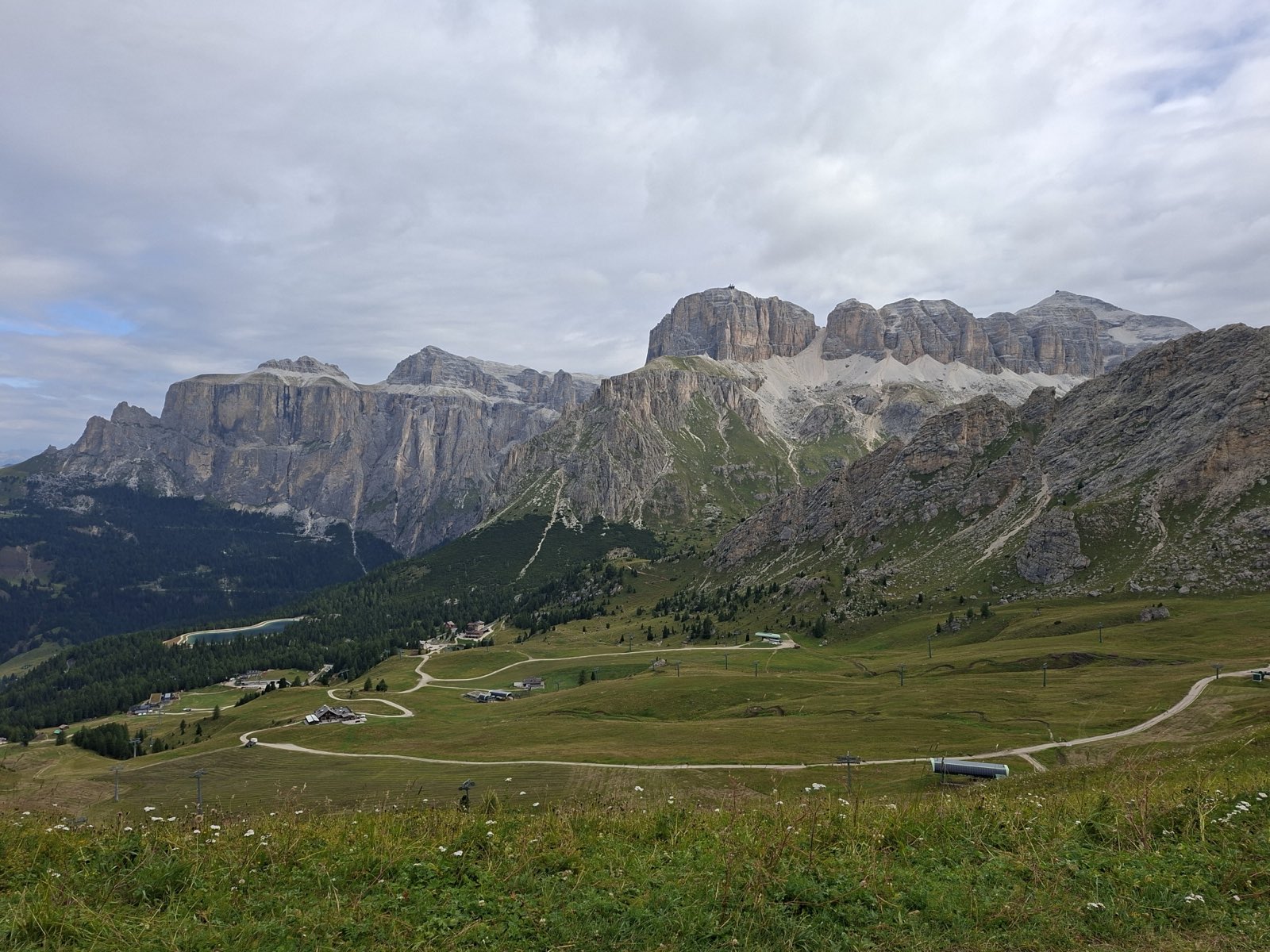
- Redistribute, not just limit: most of the pressure is concentrated on a handful of famous places. Our records for the summer of 2026 measure it: while the Passo Sella was full on 70% of the valid days, Plan de Gralba, 400 spaces a few minutes away, shows as full on only 7 days out of 77. Telling the story of the lesser-known valleys takes off the load without reducing what is on offer.
- Deseasonalise: late spring and early autumn bring golden larches, crisp air and half-empty trails.
- Regulate the large organised numbers: rules on carrying capacity and quotas reserved for the individual hiker are needed, against huts block-booked in one go.
- Education and a culture of place: clear campaigns on how to behave at altitude and on leaving no trace. Turnstiles, on their own, are not enough.
What you can do, right away
If you are planning a trip to the Dolomites in the summer of 2026, a few choices make the difference both for you and for the mountains. Check in advance whether your destination requires a reservation, like Tre Cime di Lavaredo, Braies and Seceda, and do not just show up without one.
Consider leaving the car and getting around by bus and shuttle: they are often more convenient than hunting for a parking space at dawn. Our guide on how to get around the Dolomites without a car explains how to do it in practice.
Aim for the hours at the edges of the day and for the shoulder months, when the trails can breathe: if you are not sure how to choose the timing, start from the guide on when to go. And above all, choose a less-travelled valley too: the Dolomites are not just five postcards, and the best surprises are often just a stone's throw from the crowds.
Frequently asked questions
Do you need a reservation to visit the Dolomites in 2026?
Not for the whole area, but yes for a few well-known spots. The Tre Cime di Lavaredo require a reservation for car access to the toll road, the Lago di Braies limits cars in high season and Seceda is moving towards booking time slots. Always check the area's official website before setting off.
Will there be an entry ticket for the Dolomites like in Venice?
Not for now. It is a proposal on the table, relaunched by part of the hotel sector, but the institutions are cautious and lean more favourably towards reservations, visitor caps and management apps than towards a single toll. The debate is open, but there is still no ticket in place.
When is the best time to avoid the crowds?
Late spring and early autumn, especially late September and early October, offer freer trails, crisp air and golden larches. Even on high-season days, the early morning hours and late afternoon are far less crowded than the middle of the day.
How do you reach the Tre Cime without using a car?
In high season it is best to rely on scheduled buses and shuttles, for example from Misurina, instead of booking the toll road. Getting around by public transport reduces traffic and spares you the hunt for a parking space. You will find all the details in our guide to the Dolomites without a car.