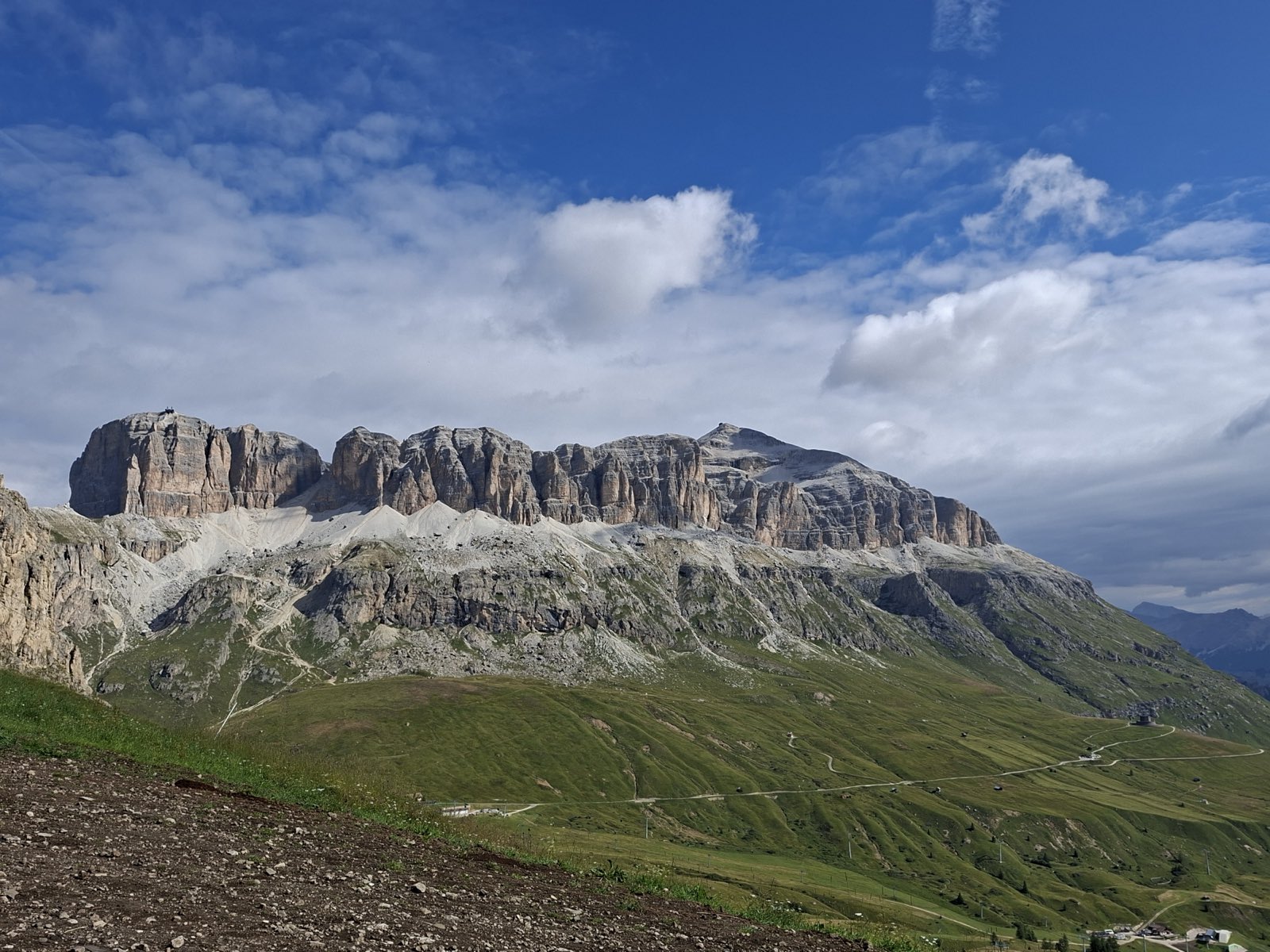
That the Dolomites are crowded in summer is obvious to anyone who has been. What nobody has ever lined up are the numbers: what time a mountain pass car park actually fills, how many hours it stays full, whether the situation is getting worse within the same season or only from one year to the next.
Since 1 June we have been recording the occupancy of seven high-altitude car parks, hour by hour. This page is updated with data up to 15 September 2026: 107 days of recording, with the season almost over.
The sharpest finding: at the Passo Sella the car park filled up on seven valid days out of ten, and in August on 25 out of 29. On full days it reached zero free spaces before 11 am almost three times out of four, and more than one time in three already between 9 and 10.
How we collected these numbers
The Autonomous Province of Bolzano publishes the free spaces of some car parks in real time through its open data portal. It is official, numeric, updated every couple of minutes. But it has one limit that makes it useless for spotting a trend: it exposes only the value right now, and keeps no record of yesterday.
We record it. Every day our system saves the hourly profile of each car park and archives it. For each hour we keep the minimum number of free spaces, that is the moment of peak pressure, which is what matters to anyone deciding what time to leave home. That is why we talk about time bands, not minutes. All times are local time: an earlier version of this article gave them in UTC, two hours behind, and was corrected on 16 September 2026.
The data on this page runs from 1 June to 15 September 2026 and covers seven car parks: Passo Sella, Passo Gardena, Plan de Gralba, Monte Pana, Sciuz, Mont Sëuc and the village garage in Selva. That is 692 recorded days, of which 517 are usable. We excluded the other 175: on 169 of them a sensor stayed stuck on the same value for all twenty-four hours, which is not a measurement but the lack of one; on six the car park showed as full even at night, and a mountain pass car park is never full at three in the morning. The Passo Gardena sensor never gave a single valid reading.
We only count valid days. That is why June and July have lower totals than in the first version of this page, which also counted the days with a stuck sensor and made June look emptier than it was.
From June to September: the curve
The Passo Sella has 199 spaces and is the most telling point we watch, because it is the gateway to one of the busiest circuits in the Dolomites. The trend within the season is unmistakable.
In June the car park filled completely on 6 of the 21 valid days, fewer than one in three, and the full period lasted little more than two hours. In July the full days rose to 24 out of 30, four in five. In August, 25 out of 29. In the first half of September the pressure eased only slightly: 10 full days out of 13.
It is not only the frequency that changes, it is the clock. In June the car park never filled before 10 am, and on two of the six full days it filled after 11. In July it was already at zero between 9 and 10 on 9 of the 24 full days; in August that happened on 13 days out of 25, more than one in two. The average length of the full period rose from 2.3 hours in June to 3.7 in August, and fell to 2.9 in the first half of September.
Across the whole season, on more than one full day in three the car park was already full before 10 am. It never filled before 9.
- June: 6 full days out of 21 valid (29%), usually between 10 and 11 am (4 times out of 6), average length 2.3 hours
- July: 24 out of 30 (80%), full between 9 and 10 am on 9 days, between 10 and 11 on 8, between 11 and noon on 7, average length 3.3 hours
- August: 25 out of 29 (86%), full between 9 and 10 am on 13 days, between 10 and 11 on 7, between 11 and noon on 5, average length 3.7 hours
- September, up to the 15th: 10 out of 13 (77%), full between 9 and 10 am on 2 days, between 10 and 11 on 4, between 11 am and 1 pm on the other 4, average length 2.9 hours
- On the worst days the car park fills between 9 and 10 am and stays full for 5 hours: it happened 15 times
Days the car park filled up, month by month
What time it fills up, on full days
It is no longer a weekend phenomenon
This is what surprised us most. In the popular picture, mountain gridlock is a Saturday and Sunday affair, and as recently as 2019 the local press still described it that way.
The 15 days with the most hours of saturation this season, five hours full, fell on every day of the week except Monday: four on a Wednesday, three on a Tuesday, three on a Saturday. On 4 August, a Tuesday, the Passo Sella was already full between 9 and 10 in the morning and stayed that way for five hours.
Spread across the days of the week, the difference narrows. On Wednesdays the car park filled 10 times out of 12, proportionally as often as on Saturdays, 11 times out of 13. The time changes only a little: on Saturdays 10 of the 11 full days were at zero by 11 am, on Wednesdays 6 out of 10. The classic advice to avoid the weekend, today, moves little: a bit of margin on the clock, not an empty car park.
Tuesday and Friday remain the statistically quietest days, but they filled 7 times out of 13, more than one in two: they are no safe haven.
When space comes back
There is one figure no guidebook gives you and that is genuinely useful: the car park empties sooner than you would think. On days when it saturated, space came back between noon and 2 pm, in almost two cases out of three already by 1 pm, and from 2 pm onwards we never found it full.
The logic is the hiker's: go up early, walk, come down in the middle of the day. Someone arriving at two in the afternoon, against every instinct, finds more room than someone arriving at ten.
This is not an invitation to turn up at 2 pm, because by then many walks no longer stand up and afternoon storms are a serious problem. But it is a real option for anyone planning a short climb, lunch at a hut or the light at the end of the day.
The paradox: the spaces exist, just not where people look for them
While the Passo Sella was full on 70% of the valid days, the Plan de Gralba car park, 400 spaces a few minutes down the road, shows as full on only 7 days out of 77, and some of those readings, late in the evening, are most likely sensor errors. Monte Pana, 340 spaces, filled 9 times out of 105, and never before 11 am. How to get up to the pass from there, with the car park fees and hours, is in our guide to parking at Passo Sella.
It is not that Val Gardena is short of parking. It is that demand concentrates on one point, the one with the most direct access to the classic circuit, and everyone arrives there at the same hour.
This is exactly the mechanism we describe in our guide to overtourism in the Dolomites: the problem is not how many people go up the mountain, but how little they are spread across space and time. These numbers measure it across a full season for the first time.
What these figures do not tell you
It is worth being explicit about the limits, because there are plenty.
The sensors cover South Tyrol and not even all of it: Trentino and the Veneto publish nothing equivalent, so the Tre Cime, Braies, Misurina, Fedaia and the Brenta Dolomites fall outside this analysis even though they are among the places under most pressure. A full car park, moreover, does not tell you how many people were there: it tells you how many cars. And we do not know how many turned around on finding it full, which is perhaps the most interesting number of all.
The Passo Sella sensor has a limit of its own, too. In the early morning it often sits at the maximum number of free spaces and sometimes jumps abruptly: on 4 August it went from 199 to 70 in four minutes. When we write that the car park never filled before 9 am, that is what the data allows us to say, not a guarantee.
Finally, one recorded season is not yet a historical comparison. We can say how this summer went, not whether it was worse than the ones before. That comparison will come, but it needs time on deposit: which is exactly why we started recording now.
Monitoring continues to the end of September
This is not a closed snapshot. We keep recording every day until the end of September, and with the full season we will publish the assessment: the absolute peak, the comparison between the months and how much really changes between August and September, which is the question anyone who can choose when to travel actually asks.
We update this page with the new figures, always stating which day they run to: this version runs to 15 September 2026. For anyone travelling in September the figure is already here: in the first half of the month the Passo Sella filled 10 times out of 13, usually between 10 am and noon.
The raw data is public and downloadable from www.ledolomiti.it/dati/stato.json, under a CC BY 4.0 licence: anyone can reuse it, commercially too, with attribution. If you work in tourism, for a local authority or in research and need a different cut of these numbers, write to us.
Frequently asked questions
What time should you arrive at the Passo Sella?
Before 9 am if you want to find a space in high season: before then, on the days we observed, it never filled, while on more than one full day in three it was already full between 9 and 10. Otherwise from 2 pm, when space had always come back, bearing in mind that the afternoon limits what you can walk and brings the storms.
Does avoiding the weekend actually help?
Far less than people think. On Wednesdays the car park filled 10 times out of 12, proportionally as often as on Saturdays (11 out of 13), and on Saturdays it fills only a little earlier. In August it filled on 25 valid days out of 29, weekdays included. Tuesday and Friday remain the freest days, but they still saturate more than one time in two.
Where do you park if the Passo Sella is full?
Plan de Gralba, 400 spaces, shows as full on only 7 valid days out of 77, and Monte Pana, 340 spaces, on 9 out of 105, never before 11 am. Val Gardena is not short of parking: demand simply concentrates on one point. From either you reach the pass by lift and a stretch on foot: the routes are in our guide to parking at Passo Sella.
Where does this data come from and is it reliable?
From the open data portal of the Autonomous Province of Bolzano, which publishes free spaces in real time under a CC0 licence. We record the time series, which the source does not keep. Of 692 recorded days we excluded 175: almost all of them with a sensor stuck on the same value for the whole day, six with the car park showing as “full” even at night. Those readings are not measurements.
Can I use this data for my work?
Yes. It is published under a CC BY 4.0 licence and downloadable in an open format: you may reuse it commercially too, citing leDolomiti.it as the source. For extracts or different cuts, write to us.
When does the full season assessment come out?
After the end of September, once we have the whole season recorded. It will cover the absolute peak, the comparison between the months and the real difference between August and September. In the meantime this page is updated with data up to 15 September 2026.