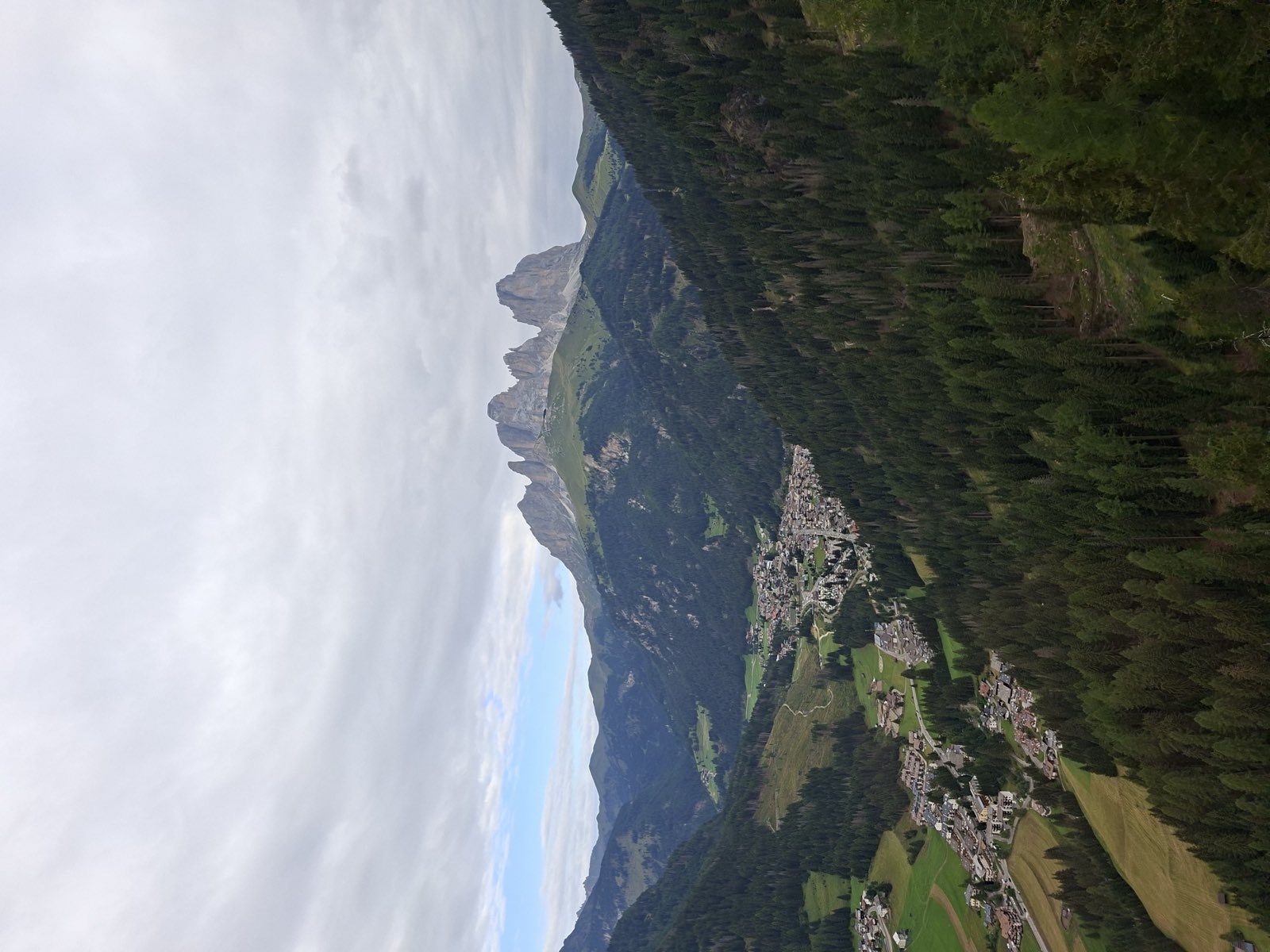
The question always arrives in the same shape: what is the best place to stay in the Dolomites? It is the wrong question, and it produces useless answers, because the best place does not exist: altitudes, distances and times do.
What really changes a holiday is not the extra star on the hotel. It is whether you leave in the morning twenty minutes from the trailhead or an hour, because in high season that hour decides whether you find a parking space or drive around for nothing. It can be measured, and we have been measuring it since June.
Here is how the system works: the altitudes, the types of accommodation and what each one means, half board, when to book and what the tourist tax adds. There is no list of properties, and at the end we explain why.
Altitude first, everything else after
In the Dolomites you sleep in three bands, and choosing between them weighs more than any other decision. The valley floor sits between 800 and 1,100 metres: these are real towns, with a supermarket, a doctor and a life that carries on in November too. It costs less, you eat at normal prices, and in summer it is warm.
The band of high villages sits between 1,200 and 1,600: Cortina, Ortisei, Corvara, Canazei, San Vigilio. This is where most of the tourist beds are, the nights are cooler and you are already halfway to the trails. It costs more, and in high season it needs booking months ahead.
Then there is real altitude, from 1,700 up: the pass villages, the isolated hotels, the mountain huts. Here you are already inside the landscape and you do not have to drive in the morning. But the options are few, often seasonal, and if the weather turns you have no fallback within reach.
- Valley floor, 800-1,100 m: cheaper, normal life all year, warmer in summer, more driving in the morning
- High villages, 1,200-1,600 m: most of the beds, cool nights, high prices, book early
- Altitude, above 1,700 m: you are already there, few options, often seasonal only
The types of accommodation, and what each one means
The words you meet while looking for a bed in the Dolomites are not synonyms, and picking the wrong one is the most common way to end up disappointed.
A garni is a hotel that serves breakfast only: no restaurant, no half board, usually family run. It works well if you plan to eat out, much less if you count on getting back tired and finding dinner ready.
A maso, in South Tyrol, is a working farm that rents out apartments: it belongs to the mountain farm-stay circuit, often has animals and its own produce, and it is the choice of anyone who wants a kitchen and some quiet. Apartments in town are the urban equivalent, closer to services and less characterful.
A mountain hut is another thing again: you sleep in a dormitory or a small room, everyone eats at the same time, and you get there on foot. It makes sense for one or two nights inside a route, not as a base for the holiday. We have twenty-two on file with altitude, valley and beds in the index of mountain huts.
- Hotel: full service, almost always half board in high season
- Garni: breakfast only, family run, right if you eat out
- Maso or farm stay: an apartment on a working farm, your own kitchen, fewer services
- Apartment in town: close to services, good for families and longer stays
- Mountain hut: up high, reached on foot, one or two nights inside a route
- Campsite: few and much in demand, book like everything else
Half board is not optional, in South Tyrol
On the South Tyrolean side of the Dolomites half board is the rule, not the exception. In high season many hotels will not even sell you the room without dinner, and anyone arriving with the idea of touring restaurants every evening ends up paying twice.
It is not a swindle, it is a model: dinner is served at a fixed hour, the menu is a short choice and the quality is almost always high, because that is where the house stakes its reputation. If you stay in Veneto or Trentino instead, room-only is easier to find.
The practical consequence: if you love eating out, look at garnis, apartments or the Veneto valleys. If you come back tired and would rather not think about it, South Tyrolean half board is exactly what you want.
When you actually book
There are three windows in which the Dolomites fill up and booking late means not finding anything: the week around 15 August, the week between Christmas and Epiphany, and the ski weeks in February.
For August and Christmas, whoever looks in May still has a choice; whoever looks in July gets what is left. For the rest of the summer, June and September stay widely available even at short notice, and that is one of the reasons they are the best months of all.
It is worth knowing that many South Tyrolean properties work on fixed weeks, Saturday to Saturday or Sunday to Sunday: asking for three nights midweek in August is often why it looks like there is no room when in fact there is.
The tourist tax, which is not in the online price
Across the Dolomites you pay a tourist tax, per person and per night. The amount is set by the municipality and changes with the category of the property and sometimes with the season, so there is no single figure valid everywhere.
The practical point is different: it is almost never included in the price you see when booking, and you pay it on site, often in cash. For a family of four over a week it becomes a sum worth budgeting beforehand rather than discovering on departure.
In many places the tax also entitles you to a guest card, which includes local public transport or discounts on the lifts. Where it exists it changes the bill for the better: ask the property for it, because not all of them hand it over unprompted.
Sleep low and leave early: the figure nobody uses
Here comes the thing we can say and almost nobody else can, because saying it takes months of recording. Since 1 June we have kept the hourly series of the car parks that publish their free spaces in real time, and what comes out bears directly on where it is worth sleeping.
At the Sella Pass, 199 spaces, the car park filled completely on 65 valid days out of 93, seven in ten, usually between 9 and 11 in the morning, and on more than one full day in three as early as between 9 and 10. It means the only safe time in high season is before 9 am, and the only variable you genuinely control is how many minutes of driving separate you from the trailhead.
Translated into a choice of bed: sleeping thirty minutes closer is worth more than one category up. And if you do sleep far away, the counter-move exists and is documented: the car park frees up again between noon and 2 pm, as we describe in the early afternoon window, and the afternoon is the empty part of the mountain.
The full picture of the season, car park by car park, is in the analysis of how summer 2026 is going, and the best days of the week are in the ranking from the data.
Why you will not find a list of hotels
We considered it and decided against. A list of properties we have not checked, with prices that change weekly and availability that changes daily, would be the least reliable part of the whole site, and it is the exact opposite of why we exist.
Everything we publish as data carries a source and a verification date, and gets rechecked when it expires: it is written on the page about the data we check. Applying that standard to two thousand hotels is beyond us today, and publishing them without that standard would be cheating.
What we can do, and are doing, is explain how the system works, so you choose better on whatever booking site you use. When we have properties we can genuinely answer for, because we have been there or because there is an agreement with our name on it, we will write it and say plainly what it is.
Frequently asked questions
What is the best place to stay in the Dolomites?
There is no single best place: there is the right altitude for what you want to do. Valley floor between 800 and 1,100 metres to spend less and have services, high villages between 1,200 and 1,600 to be halfway to the trails, above 1,700 to be inside the landscape with few alternatives if the weather turns.
What is the difference between a hotel and a garni?
A garni serves breakfast only: no restaurant and no half board, usually family run. It is fine if you plan to eat out, much less so if you come back tired and want dinner ready.
Do I have to take half board?
On the South Tyrolean side, often yes: many hotels in high season will not sell the room without dinner. In Veneto and Trentino room-only is easier to find. If you love eating out, look at garnis, apartments or the Veneto valleys.
How far ahead should you book?
For the week around 15 August, for Christmas and for the February ski weeks it is worth moving by May. June and September stay widely available even at short notice, which is one of the reasons they are the best months.
Is the tourist tax included in the price?
Almost never. You pay it on site, per person and per night, and the municipality sets the amount according to the category of the property. In many places it entitles you to a guest card with public transport included: ask for it, because not every property hands it over unprompted.
Better to sleep near the trails or save money staying far away?
The data says near. At the Sella Pass the car park usually fills between 9 and 11 am, and it saturated on 65 valid days out of 93. The only safe time is before 9 am, so thirty minutes less driving in the morning is worth more than one category up. If you sleep far away, the counter-move is to arrive in the early afternoon, when the car parks free up again.
Why is there no list of hotels on this site?
Because we have not checked them. Everything we publish as data carries a source and a date of verification, and a list of properties with prices and availability changing daily would be the least reliable part of the site. When we have properties we can genuinely answer for, we will write it and say plainly what it is.