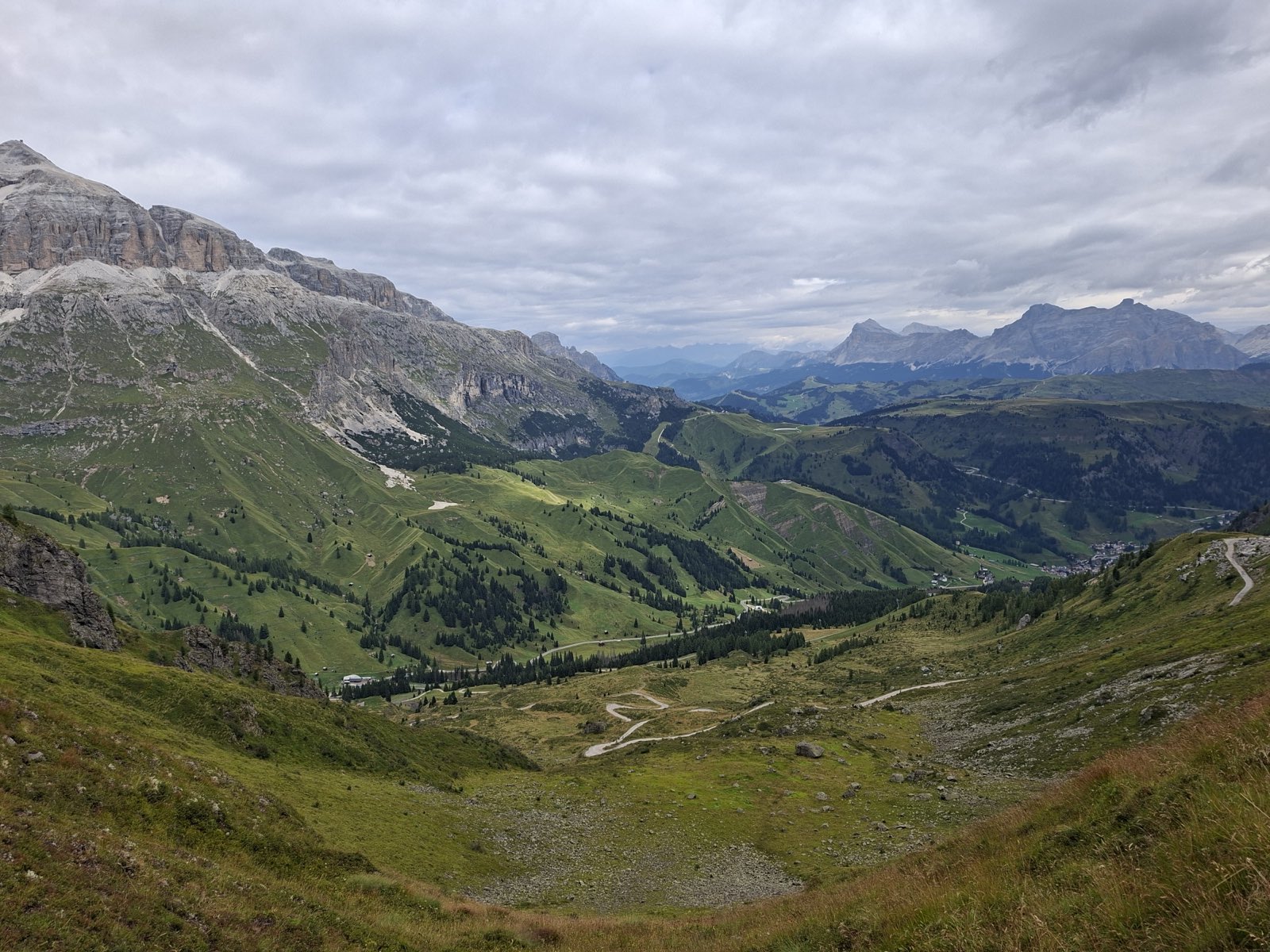
The Dolomites on a bike are a different mountain. The pace is slower than a car and faster than your feet, and it takes you where the big roads don't go: along the rivers, on the old railway lines, between the farmsteads. You don't need to be an athlete. You just need the right bike and the right route.
And there's a route for everyone. There's the family pedalling flat along the cycle path with kids, there's the one grinding gravel on a mountain bike, the one taking on the passes with a road bike, and the one who, with an e-bike, gets up there without wrecking their legs. The same valley changes character depending on how you ride it.
This guide helps you find your way: the finest and easiest cycle paths, mountain biking, e-bikes, the great road passes, where to rent and how to get around with a bike. For the full list of routes, start from the mountain biking and e-bikes section. For the rest, read on.
Easy cycle paths, families included
If you're after a relaxed ride, the Dolomites have some of the finest cycle paths in the Alps, almost all on tarmac or compact gravel with gentle gradients. The queen is the Val Pusteria cycle path, which follows the valley floor for dozens of kilometres between meadows, villages and onion-domed bell towers, with the peaks always in view. It's wide, signposted and suitable for everyone, children included.
The other great classic is the Dobbiaco-Cortina cycle path, built on the bed of the old railway. Precisely because it started as a rail line, the gradients are soft and steady: in the Dobbiaco to Cortina direction it's almost all downhill, which makes it perfect even if you're not fit. Around the lakes you'll then find easy loops like the one at Lake Dobbiaco.
The nice thing about these paths is that you can get back without retracing the whole route: many are served by buses and trains that carry bikes. So you choose how far to pedal and get a lift back to the start.
- Val Pusteria cycle path: long, flat, scenic
- Dobbiaco-Cortina: on the old railway, gentle gradients
- Lake loops (Dobbiaco): short and for everyone
- Easy return by bus and train, both carry bikes
The Long Way of the Dolomites
If you have a day and the urge for a proper route, the Long Way of the Dolomites is the great old-railway itinerary that links Dobbiaco to Cortina and carries on toward Calalzo di Cadore. It crosses some of the finest scenery in the Ampezzo Dolomites, through tunnels, viaducts and old stations turned into rest stops.
The best-loved stretch is the Dobbiaco-Cortina: around 30 kilometres of gentle descent, doable even on a normal bike and with children, with plenty of tasty stops along the way. Those who want to go further carry on toward Calalzo, where the railway starts again: bike on the train and an easy ride home.
It's a route that pleases everyone, from the sporty type to the family on holiday. To sort out timetables and transport, take a look at the travel guide.
Mountain biking: gravel and single track
If you love gravel, the Dolomites have plenty to offer. Pastures, forest roads, single track and bike parks link valleys and huts, and in summer many lifts carry your bike so you skip the climb and enjoy the descent.
The best-equipped areas have networks of signposted routes for every level, from scenic loops across the pastures to technical trails for those who can handle them. A classic on an e-bike or a muscle MTB is the tour of the Alta Badia passes and huts, which climbs onto the Pralongià plateau with an open view over the Sella and the Marmolada.
The rule is the same as for hiking: choose the route based on your real experience, bring a helmet, a spare inner tube and a few tools, and check the weather. You'll find all the options in the mountain biking and e-bikes section.
E-bikes: the Dolomites without the suffering
The e-bike has changed the rules of the game. With pedal assist you reach huts and pastures that used to be for fit legs only, and the climb stops being a problem. It isn't cheating: you still pedal, just with a push.
E-bike rental is everywhere now, and many hotels provide them. The Alta Badia e-bike tour is the perfect example: a loop that would eat up a whole day on foot, on an e-bike you do it at your own pace and still have energy to enjoy the view and a stop at a hut.
A practical tip: keep an eye on the battery and set off fully charged. At altitude, with the cold and the climbs, the range drops faster than you'd think.
The passes on a road bike: the cyclists' mountain
For anyone with road cycling in their blood, the Dolomite passes are a pilgrimage: Pordoi, Sella, Gardena, Falzarego, Giau. Hard, legendary climbs, the same ones that make the history of the Giro d'Italia, with hairpins by the dozen and views that repay every pedal stroke.
The highlight is the days made for cyclists. Some summer dates close the passes to cars and leave them to bikes alone, like the Sellaronda Bike Day around the Sella group, which in 2026 returns on 12 September and suspends the buses for the whole day too. And then there's the Maratona dles Dolomites, the Alta Badia gran fondo that every year draws thousands of cyclists from all over the world.
These are dates worth the trip, but they shift the crowds and the accommodation, so it's worth knowing them in advance and booking. The exact dates change every year: check the valley's official calendars.
Rental, bike transport and logistics
You don't have to bring your own bike. In the main centres, from Dobbiaco to Cortina to Alta Badia, you'll find well-stocked rentals with city bikes, mountain bikes and e-bikes, often with a helmet and a child seat included. Many also offer drop-off at a different point from the start, which is handy for the valley-floor cycle paths.
The big ally is public transport: several trains and buses in the area carry bikes, so you pedal one way and get an easy ride back the other. It's the secret to enjoying the cycle paths downhill without having to climb back up.
Before you set off, always check the timetables and the availability of bike spaces on board, which sell out in high season. You'll find the service information in the travel guide.
When to go cycling in the Dolomites
The cycling season runs roughly from May to October. The valley-floor cycle paths, like Val Pusteria, open early and stay pleasant for a long stretch, while the high passes are at their best from June to September, once the snow is gone and the roads are clear.
Summer is the peak: long days, everything open, but also more traffic and more heat in the middle of the day. September, as with hiking, is often the sweet spot: cool air, soft light and fewer people. To work out the right period, there's the guide on when to go to the Dolomites.
Frequently asked questions
Which are the most beautiful cycle paths in the Dolomites?
The two great classics are the Val Pusteria cycle path, long and almost flat along the valley floor, and the Dobbiaco-Cortina, built on the old railway with gentle gradients. Both are family-friendly and served by buses and trains that carry bikes for the return.
Is the Dobbiaco-Cortina cycle path downhill and good for kids?
Yes. It was built on the bed of an old railway, so the gradients are soft and steady, and in the Dobbiaco to Cortina direction it's almost all downhill. It's doable even on a normal bike and with children, with plenty of possible stops along the way.
Where do you rent bikes and e-bikes in the Dolomites?
In the main centres like Dobbiaco, Cortina and Alta Badia you'll find well-stocked rentals with city bikes, mountain bikes and e-bikes, often with a helmet and child seat. Many also offer drop-off at a different point from the start, useful for the valley-floor cycle paths.
Do you need a mountain bike or is an e-bike enough?
It depends where you want to go. For the valley-floor cycle paths a city bike or a normal bike is enough. To reach pastures and huts without too much effort, an e-bike is ideal. A muscle mountain bike is what you want for demanding gravel and technical single track.
What's the best time to cycle in the Dolomites?
The season runs from May to October. The valley-floor cycle paths are pleasant for most of that stretch, while the high passes are at their best from June to September. September combines cool weather, lovely light and fewer crowds.