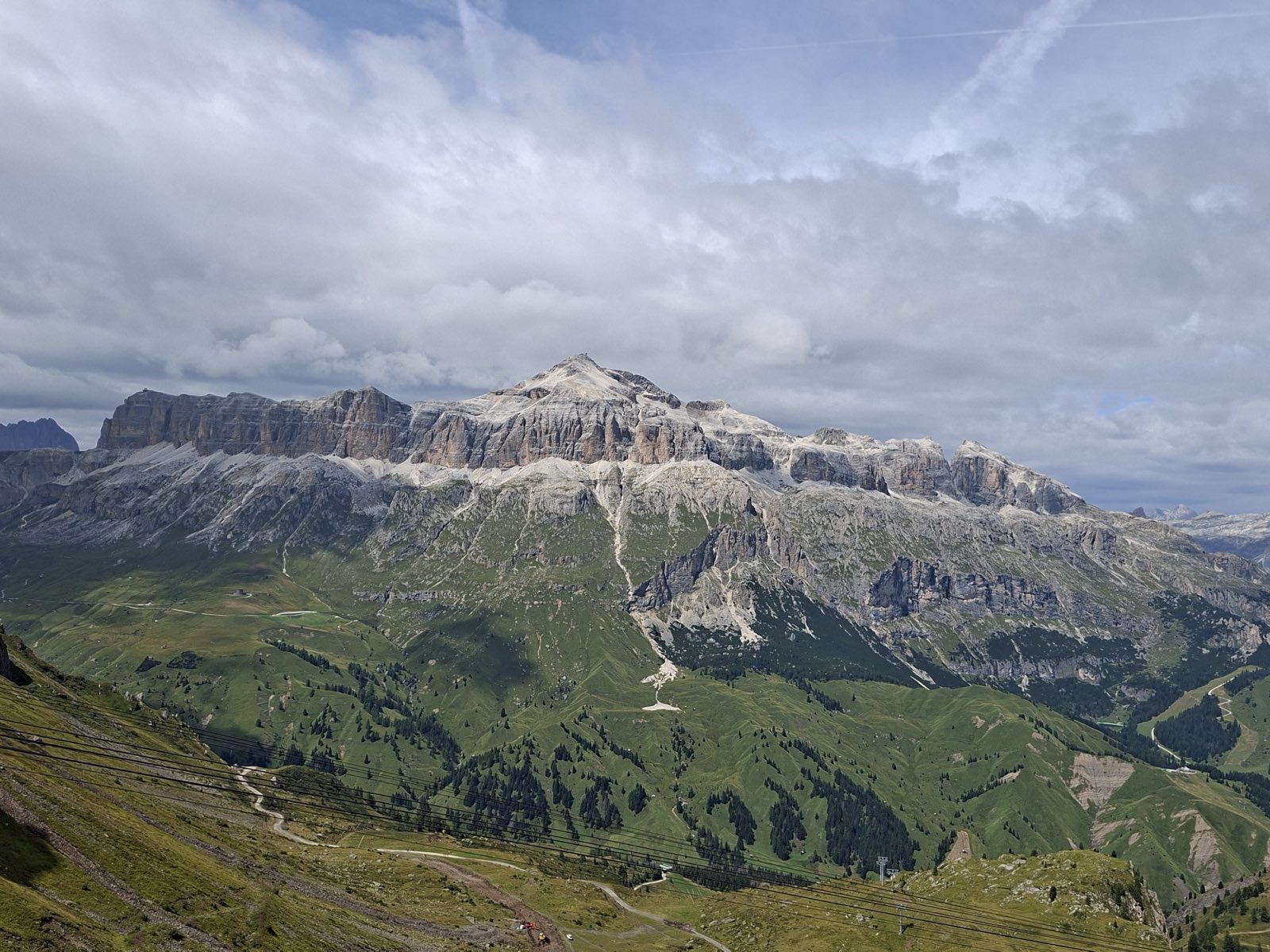
The loop over the four passes around the Sella group is one of the most travelled roads in the Alps: Sella, Pordoi, Campolongo and Gardena, a little over fifty kilometres, a ring that closes on itself.
You can drive it clockwise or anticlockwise, and every guide says it makes little difference. For the scenery, that's true. In practical terms it isn't, and the data shows it precisely.
The bottleneck has a name and a time
Of the four passes, only one has a car park with a public sensor that publishes free spaces: Passo Sella, 199 spaces. It's also where almost everyone stops, because it's the start of the loop around the Sassolungo.
Over 93 valid days logged between June and mid-September it filled completely 65 times, seven in ten, usually between 9 and 11 in the morning and never before 9, and stayed full for a little over three hours. For the other three passes we have no direct data and we don't make any up: what we can say concerns the Sella, and that's enough, because that's where the loop seizes up.
The consequence is simple: your direction of travel decides what time you reach the critical point.
Where you start, and so which way to go
If you start from Val Gardena and drive anticlockwise, Passo Sella is the first pass you reach, a few minutes after setting off. That works if you get there before 9 am, so leave early, say by 8.
If you set off after 9, go clockwise: Gardena, Campolongo, Pordoi and the Sella last. If you stop along the way, you get there in the early afternoon, which is when the car park frees up again, because the people who went up in the morning are starting to come down: from 2 pm onwards we never found it full.
From Arabba or the Val di Fassa the reasoning shifts accordingly: what counts is not the direction as such, it's what time you are at the Sella.
- Leaving Val Gardena by 8 am: anticlockwise, Sella first, before 9
- Leaving after 9: clockwise, Sella last, in the early afternoon
- Avoid: reaching the Sella between 10 am and 1 pm, the worst window
- Fallback if it's full: Plan de Gralba, 400 spaces, almost always free
What the data doesn't tell you
A full car park is not the loop's only problem: on peak days traffic crawls on the hairpins even when it doesn't stop, and some passes in the Sella group may have summer time restrictions that change from one season to the next.
Above all, our sensors measure parked cars, not queuing ones. A pass can flow freely while its car park is full, or be jammed while there are spaces to spare.
If you are planning the loop, the Passo Sella page and our guide to driving the passes cover the restrictions and the route; here we only add the time of day, the one variable nobody measures. Times are local and given as bands, because our series is hourly: an earlier version of this page gave them in UTC, two hours behind, and was corrected on 16 September 2026.
Frequently asked questions
Which way round should you drive the four-pass loop?
It depends on when you set off. From Val Gardena, if you leave by 8 am, go anticlockwise and take Passo Sella straight away, before 9; if you leave after 9, go clockwise and, stopping along the way, reach the Sella in the early afternoon, when the car park frees up again.
What time does the Passo Sella car park fill up?
Usually between 9 and 11 am, and on more than one full day in three as early as between 9 and 10; it never filled before 9. Over 93 valid days it filled completely 65 times, staying full for a little over three hours.
And if I find it full?
Plan de Gralba, 400 spaces a few minutes away, shows as full on only 7 valid days out of 77. From there you reach the pass on the Piz Seteur gondola and the Gran Paradiso chairlift, then 25 minutes on foot along path 526, while the lifts are running. The routes are in our guide to parking at Passo Sella.
Is there data on the other three passes too?
No. Passo Sella is the only one of the four with a car park fitted with a public sensor that publishes free spaces. For the others we have no direct measurement, and we don't present estimates as if they were one.