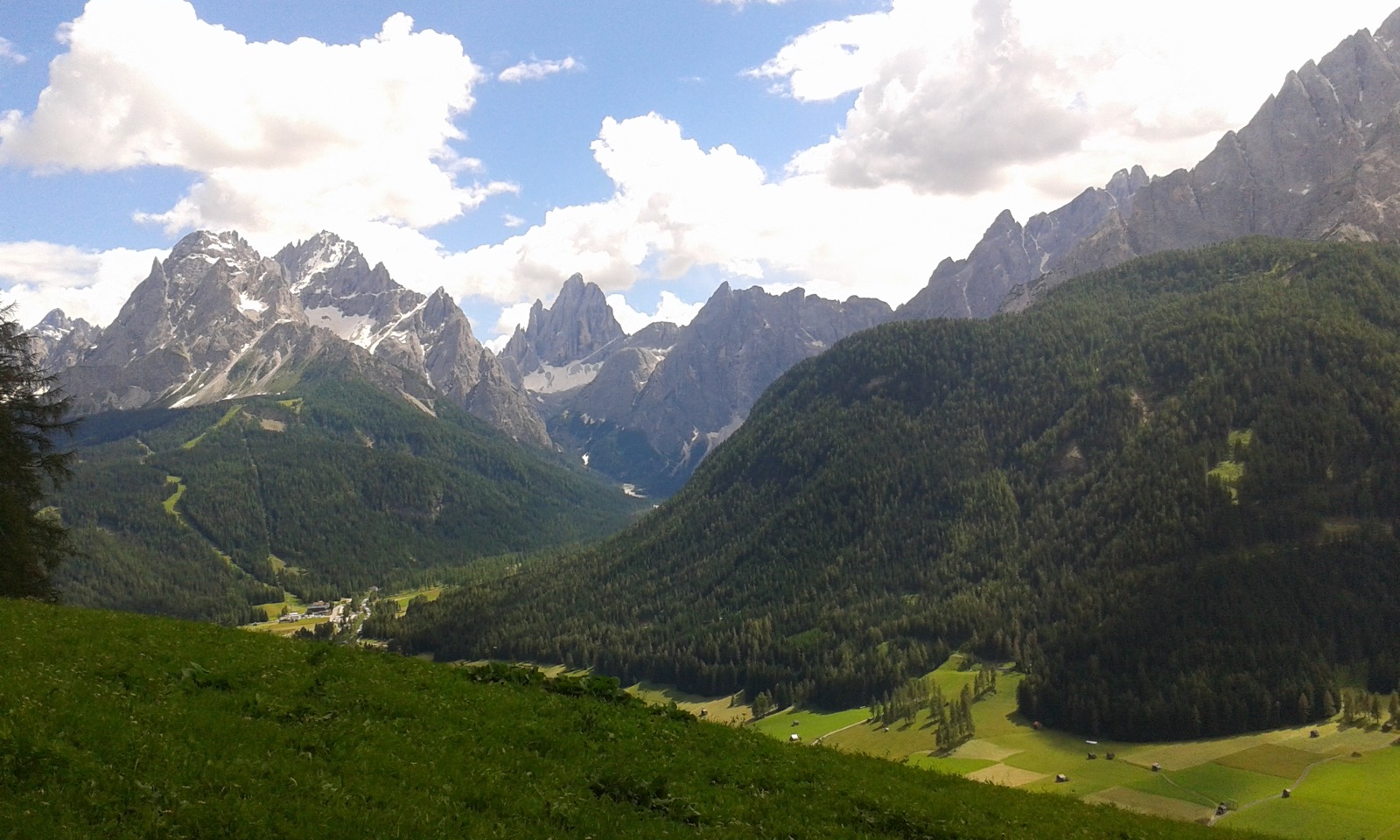
Above Sesto, in the Alta Pusteria, five peaks are named after an hour. The sun passes over them one after another, from morning into early afternoon, and the peak it stands over tells you the time.
How well it tells it, though, nobody writes. The sources do not even agree on where to stand.
So we calculated it: the sun's position, the peaks' coordinates, the shape of the ground. The result is more interesting than the legend.
Five peaks, five hours
The original names are German, because Sesto is a German-speaking village: Neuner, Zehner, Elfer, Zwölfer, Einser. Almost every peak also has an Italian name, and it pays to know both, because maps use one or the other.
Some sources add an Eight, the Croda Sora i Colesei, but German Wikipedia notes that it stands too close to the Nine to really count.
- Nine, Neuner: Pala di Popera, 2,582 m
- Ten, Zehner: Croda Rossa di Sesto, in German Sextner Rotwand, 2,965 m
- Eleven, Elfer: Cima Undici, 3,092 m
- Twelve, Zwölfer: Croda dei Toni, 3,094 m
- One, Einser: Cima Una, 2,698 m
Watch out for Nine
Nine is the easiest peak to get wrong. It is the Pala di Popera, east of the Croda Rossa: German Wikipedia says so, as do the mountain guides who run the traverse and the peak databases.
Italian Wikipedia, on the other hand, links it to Monte Popera, which is a different mountain, and another entry gives as Nine a Cima Nove above Dobbiaco. Seen from Sesto, that one lies almost due west. At nine in the morning the sun is in the south-east, and it cannot stand above it.
This is not pedantry. The Dolomites are full of peaks named after hours, and they get mixed up. There is a Sasso delle Nove in the Fanes group, tied to another sundial, and a second Sasso delle Nove in the Sella group, some fifteen kilometres away. While we were building our map of the Dolomites, the second one nearly moved the Fanes group's label by fifteen kilometres.
Where to watch from: the sources disagree
Most sources point to Moso, at the mouth of the Val Fiscalina. Others say Bagni di Moso, others the Val Fiscalina itself. The Sesto tourist office points to the main road between the Haus der Berge and Moso: walking along the pavement you reach a stone marker that explains the peaks.
The difference matters. In winter, between nine and ten, the sun moves about a dozen degrees along the horizon, and a few hundred metres on the valley floor are enough to change the angle at which you see a peak. A mountain sundial is accurate, if at all, from one precise spot.
The calculation
We took the peaks' coordinates from OpenStreetMap, checking them against a second source, and for each viewpoint we worked out the direction in which each peak lies. Then, for every day of the year, we found the moment the sun is in that direction, using the astronomical algorithm of NOAA, the US weather and oceans agency.
We also checked on the digital terrain model that the peaks can actually be seen from each spot, rather than hiding behind a nearer slope. It is not a formality: the spot that works best on geometry alone lies on the Val Fiscalina road, and from there the morning peaks cannot be seen at all, because the slope three hundred metres away blocks them.
From the spot the tourist office points to, halfway along the road between the Haus der Berge and Moso, all five peaks are visible. At the winter solstice the sun passes over them at these times, with the gap from the hour in the name:
- Nine, Pala di Popera: at 10:15, an hour and seven minutes late
- Ten, Croda Rossa di Sesto: at 11:03, 55 minutes late
- Eleven, Cima Undici: at 11:20, 11 minutes late
- Twelve, Croda dei Toni: at 12:11, 3 minutes late
- One, Cima Una: at 12:47, 21 minutes early
Why Twelve does not miss
Twelve is on time, the hours near noon are close enough, the morning ones are not. The reason is geometry: from that stretch of road the Croda dei Toni lies almost exactly due south, and the sun is exactly due south at true noon on every day of the year. That is why Twelve is the only hour on the sundial that does not depend on the season.
The gaps we give are in solar time. The clock is another matter: Sesto lies west of the meridian our time zone is set to, the equation of time shifts noon by a few minutes over the year, and in summer there is daylight saving. The sun passes over the Croda dei Toni at these clock times:
- 21 December: 12:11
- 1 February: 12:26
- 20 March: 12:20
- 21 June: 13:13
- 23 September: 13:05
- 1 November: 11:56
Why it works better in winter
The official sources say the sundial reads best in winter, and the calculation shows why. The hours in the names are solar hours, and in summer the sun is so high that it crosses the arc of the five peaks in much less time.
At the summer solstice, from the same spot, the sun passes over the Pala di Popera, Nine, at 12:24 by the clock: more than two hours behind solar time. It passes over the Cima Una at 13:28. Between Nine and One there are just over sixty minutes, where in winter there are a hundred and fifty.
There is another reason in winter. On 21 December the noon sun is about twenty degrees high, while from the road the Croda dei Toni stands about a dozen degrees above the horizon: the sun passes just above it, and that is where you catch the effect.
At sunset, on the other hand, the sundial marks nothing. The sun is on the opposite side.
Where the sundial works best
We searched the whole basin for the spot from which all five peaks are visible and mark the hour with the smallest error. The best one lies on the slope above Bagni di Moso, at around 1,500 metres, and even from there the average gap is about twenty minutes. The perfect sundial does not exist.
Moso, which many sources call the historic spot, is instead one of the worst for the morning hours: from there Nine runs an hour and a quarter late. It is, however, the right place for One, which from Moso is off by a minute. From the Haus der Berge, at the other end of the road, it is Eleven that is accurate.
These figures come from a terrain model with a grid of about thirty metres. We have not checked them on the spot with a watch in hand, and anyone who does would do us a favour by writing in.
The other sundials of the Dolomites
Sesto is not the only place where the mountains are named after the hours.
- In Alta Badia, in the Fanes group, the Sas dles Nü and Sas dles Diesc, Sasso delle Nove and Sasso delle Dieci, above 2,900 metres. According to German Wikipedia they are read from La Val.
- In the Sella group, above the Val de Mesdì, the "noon valley", another Sasso delle Nove and another Sasso delle Dieci. We found no source saying which village they are read from.
- In Val di Fassa, above Pozza, the Cima Undici and Cima Dodici of the Monzoni group.
Getting there
The Haus der Berge, the visitor centre of the Tre Cime nature park, is on the main road through Sesto. From there towards Moso you walk along the pavement to the stone that explains the peaks: it is the simplest way to see the sundial, on the flat and in the village.
The peaks themselves are not for hikers. According to the South Tyrolean mountain guides, the normal routes on Nine, Eleven and One are grade III, the one on Twelve grade IV, and the Croda Rossa is climbed by via ferrata. The local guides run a traverse of all five over several days.
To see them up close without climbing there is the Val Fiscalina, which can also be reached by bus from Sesto. The South Tyrolean side of the peaks lies in the Tre Cime nature park, part of the Dolomites UNESCO World Heritage Site.
Frequently asked questions
Which peaks make up the Sesto sundial?
Five: Nine is the Pala di Popera (2,582 m), Ten the Croda Rossa di Sesto (2,965 m), Eleven the Cima Undici (3,092 m), Twelve the Croda dei Toni (3,094 m) and One the Cima Una (2,698 m). In German they are the Neuner, Zehner, Elfer, Zwölfer and Einser. Some sources add an Eight, the Croda Sora i Colesei.
Where do you watch the Sesto sundial from?
The Sesto tourist office points to the main road between the Haus der Berge and Moso, where a stone marker explains the peaks. All five are visible from there, and by our calculation the Croda dei Toni marks noon to within three minutes. Moso is the most quoted spot, but from there the morning hours are off by more than an hour.
Is the Sesto sundial accurate?
Only in part. Twelve, the Croda dei Toni, marks true noon to within a few minutes all year, because from the viewpoint it lies almost exactly due south. The other hours are approximate: at the winter solstice the sun reaches Nine and Ten about an hour late.
What time is the sun over the Croda dei Toni?
From the road between the Haus der Berge and Moso, at 12:11 on 21 December, at 12:26 on 1 February, at 13:13 on 21 June with daylight saving and at 11:56 on 1 November. That is true noon in Sesto, which does not match twelve on the clock.
When is the sundial best seen?
In winter, between mid-morning and one o'clock. In summer the sun is so high that it crosses the five peaks in little more than an hour, and the morning hours run more than two hours late. At sunset the sundial marks nothing: the sun is on the opposite side.
Can you climb the sundial peaks?
Yes, but not on foot: the normal routes are climbs, grade III on Nine, Eleven and One and grade IV on Twelve, while the Croda Rossa is climbed by via ferrata. The local mountain guides run the full traverse over several days.