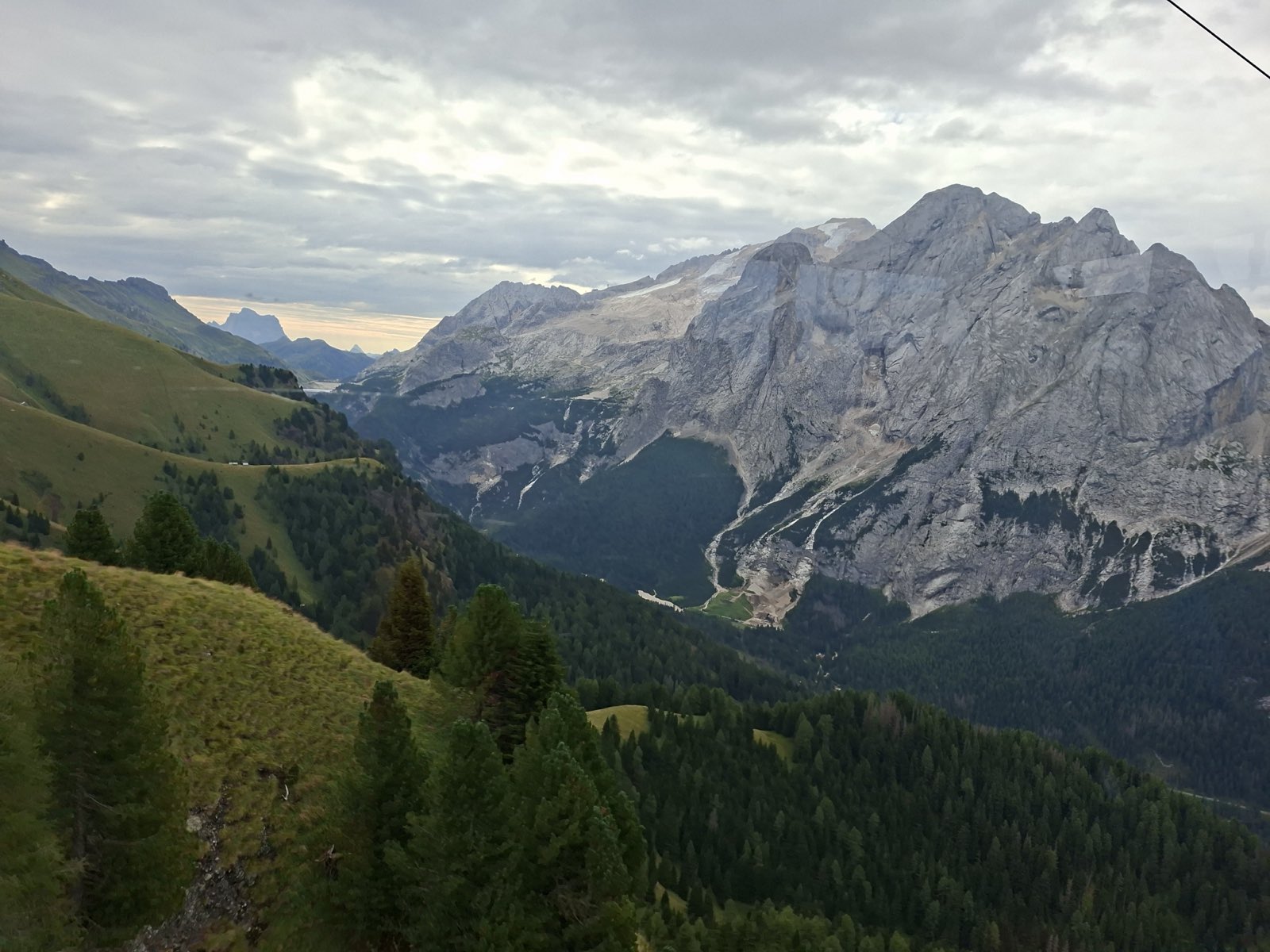
Some mountains you look at, and some look back at you. The Dolomites are the second kind. People called them the Pale Mountains centuries before it became a tourist label, because at sunset the rock catches fire in pink and copper. Around here they call it enrosadira. The first time you see it, you understand why people keep coming back.
Don't expect a tidy checklist. The Dolomites are dozens of mountain groups scattered across Trentino, South Tyrol and Veneto, and since 2009 they've been a UNESCO World Heritage Site: nine mountain systems, eighteen peaks above 3,000 metres, more than 140,000 hectares. Translation: you could come back ten times and still find a valley you never knew was there.
This isn't the usual list of Instagram spots to tick off in a hurry. It's more of a mental map: the landmark places worth the wait, the valleys where you'll want to stay the night, the things that stick with you. If you'd rather start from the areas, here are the Dolomite areas; if you already want a ready-made route, head to the itineraries. Otherwise, keep reading.
The Tre Cime di Lavaredo: the absolute icon
If the Dolomites had a logo, this would be it. Three towers of rock planted in the Cadore sky, the most recognisable profile in the Alps. Seen from the north face of the Tre Cime di Lavaredo it's almost vertical, and no photo captures even half of what you get in person.
The right way to experience them is to walk around them. The Tre Cime di Lavaredo loop is a classic ring, doable by anyone who can handle a few hours on foot, and it changes face at every bend: rock walls, scree slopes, historic mountain huts. You set off from the Auronzo and Misurina area, where the toll road up to the refuge ends.
A tip from someone who's been more than once: get there early. In summer the car parks fill by mid-morning, and the best light comes at dawn and sunset anyway, when the walls change colour.
- Best view: the north face, along the loop
- When: June to October, once the trails are clear of snow
- Where to base yourself: Misurina or Auronzo di Cadore
The lakes that look painted: Braies, Sorapis, Misurina
The Dolomites hide stretches of water where you'd least expect them. The most photographed is the Lake Braies with its wooden boats, in Val Pusteria: dark green water, the wooden jetty, the Croda del Becco mirrored in it. Gorgeous, and packed with people. Same rule as the Tre Cime: dawn or nothing.
If you want something wilder, aim for Lake Sorapis: a turquoise so vivid it looks fake, and you earn it only on foot with a serious walk (watch out for the exposed sections). Lake Misurina, on the other hand, is easy to reach: the largest natural lake in the area, perfect as a stop before heading up to the Tre Cime.
And don't forget Lake Carezza at the foot of the Latemar, the most fairy-tale of the lot, with colours that shift depending on the light and fir trees all around. To build a lake tour of your own, start from the activities section.
Seceda and the high plateaus that feel like another planet
There are spots where the horizon suddenly opens up and the mountain turns into pure geometry. Seceda, above Val Gardena, is one of them: the grassy ridge that drops away onto the spires of the Odle. If I had to pick a single image of the Dolomites, it's probably this one.
You can ride up the easy way on the lifts. But if you've got the legs and the time, walk the Seceda loop and earn the view one step at a time. You get the same feeling on the Alpe di Siusi, the largest high-altitude plateau in Europe, where the rolling meadows just never end.
Further south everything changes. The Pale di San Martino plateau is a desert of pale stone, almost lunar. Three very different places, the same sense of having shifted to another planet.
The Catinaccio, the enrosadira and the legend of King Laurin
If there's one place where the enrosadira is at its best, it's the Catinaccio with the Rose Garden. At sunset the walls turn bright red. Legend says it's the curse of King Laurin, the king of the dwarves who turned his rose garden to stone so no one could admire it again, but forgot about the hour of dusk.
Behind the fairy tale there's chemistry. Dolomite rock is rich in calcium and magnesium, and under the low light of dawn and sunset it shifts toward pink and purple. That's why these mountains are called the Pale Mountains, and it's a sight that on its own is worth the trip.
You get a good look at the Catinaccio from Val di Fassa and the surrounding South Tyrolean valleys. If you want to understand why these landscapes really matter, read the page on the Dolomites UNESCO World Heritage.
Marmolada and Civetta: the giants of rock and ice
You can't talk about the Dolomites without looking up at the Marmolada, the highest peak in the group, the Queen. The cable car up the Marmolada glacier takes you high up, looking out over dozens of mountain groups. Up there you'll also find a museum about the Great War, which was fought here among the ice, at altitudes where even breathing was hard work.
The base for getting around this area is Arabba and the Marmolada, lovely in winter too. A little further on stands another colossus, the Civetta: its north-west face is one of the biggest walls in the Alps, and climbers call it the Wall of Walls. That nickname wasn't handed out lightly.
These two giants sum up the double nature of the Dolomites: on one side gentle meadows and lakes, on the other walls and ice that made the history of mountaineering.
The valleys to live in: where the heart of the Dolomites beats
The peaks make the photos, but it's the valleys that bring you back. Alta Badia and Val Gardena are the Ladin heartland: a language, a cuisine and traditions that have held for centuries. Val di Funes, with the little church of San Giovanni in Ranui below the Odle, is one of those postcards that look fake. They aren't.
On the Veneto side there's Cortina d'Ampezzo, more glamorous, a great base for the Cinque Torri: a cluster of spires that was a First World War front line and is now an open-air museum. If you're after quiet instead, head for valleys like Val di Fiemme, Val di Zoldo or the San Vigilio and Marebbe area.
Every valley has its own character: glamorous or quiet, Ladin or Tyrolean, big hotels or mountain farmsteads. Choosing the valley is already half the trip. Start from the areas.
- Val Gardena and Alta Badia: Ladin tradition and huge views
- Val di Funes: the Odle and San Giovanni in Ranui
- Cortina d'Ampezzo: elegance, history, access to the Cinque Torri
- Val di Fassa: below the Catinaccio and the Marmolada
The Dolomite passes: the journey is the experience
Here the road isn't just how you get there: it's half the show. The Dolomite passes, Pordoi, Sella, Gardena and Falzarego, link the valleys with hairpins that look like they were drawn on purpose. Motorcyclists and cyclists know each one by heart.
The four-pass loop around the Sella is one of the finest road rings in Europe. You can do it by car, by motorbike or, if your legs are up to it, by bike. The view changes at every hairpin, and at the cols you'll find huts where you can stop to eat with a view.
Before you set off, take a look at the practical guide: in high season the passes clog up, and in winter some close for snow. Better to know that than to find yourself stuck in a queue at 2,000 metres.
Sleeping and eating: the taste of the Dolomites
A day in the mountains ends at the table, full stop. Traditional Dolomite cooking sits halfway between Italy and the Tyrol: canederli, casunziei, speck, alpine cheeses, then strudel and kaiserschmarrn. It's border cooking, and you can taste it in every bite.
For where to sleep and eat the choice is huge and changes from valley to valley: a high-altitude refuge, a restored farmstead, a charming hotel, a working farm. Where you sleep decides the kind of holiday you'll have.
One bit of advice: treat yourself to at least one meal in a hut you reached on foot. Canederli after three hours of walking taste like something no restaurant in town can copy. I know, put like that it sounds over the top. Try it, then we'll talk.
Frequently asked questions
When's the best time to visit the Dolomites?
It depends on what you're after. In summer, June to September, you'll find clear trails, open lakes and refuges. Autumn brings colour and fewer people. Winter is the season for skiing and snowy landscapes. Spring is a transition: high up, many lifts and trails are still closed. For getting around and planning, see the site's practical guide.
How many days do you need to see the Dolomites?
For a first taste, four or five days are enough if you pick one valley as a base. To see different areas, say Val Gardena and the Cortina area, count on seven or more, moving your base halfway through the stay. Seeing it all in one go isn't possible: it's simply too vast.
What can you see in the Dolomites in a single day?
With just one day, focus on one landmark: Lake Braies, the Tre Cime di Lavaredo loop, or the climb up to Seceda. These are very popular spots, so get there at dawn: better light and no crowds.
What is the enrosadira of the Dolomites?
It's the moment at dawn and sunset when the dolomite walls turn pink, red and purple. It happens because of the rock's composition, rich in calcium and magnesium, which reflects the low light of the sun. The Catinaccio is one of the best places to see it, and legend ties it to the curse of King Laurin and his rose garden.
Why are the Dolomites a UNESCO World Heritage Site?
They've held the status since 2009, for the exceptional value of their landscape and geology: nine mountain systems, eighteen peaks above 3,000 metres and more than 140,000 hectares of vertical walls, spires and deep valleys. You'll find more detail on the dedicated Dolomites UNESCO page.