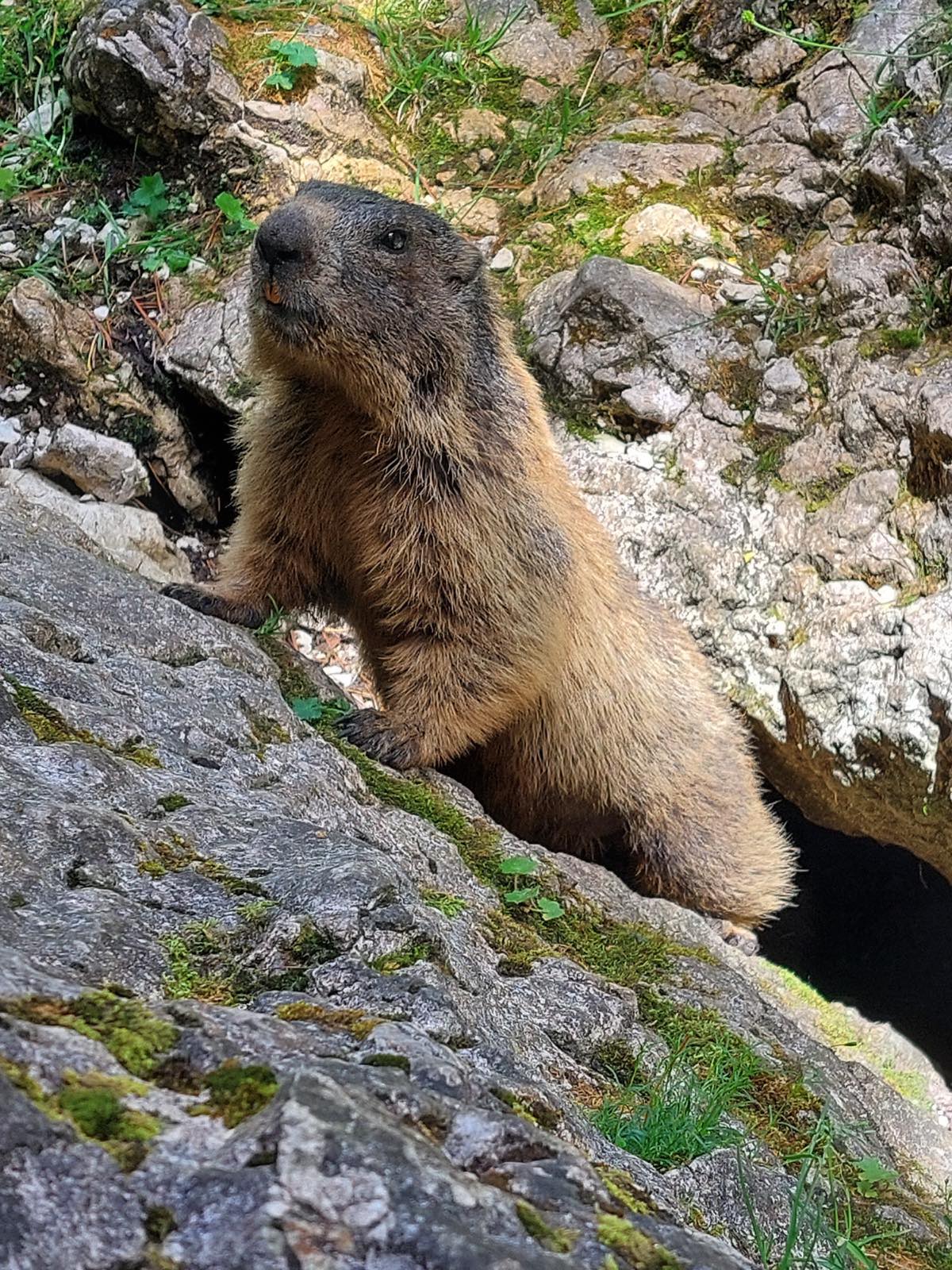
You never forget the first encounter. You're walking across a slope of pasture, the sun is high, and all of a sudden you hear a sharp whistle that goes straight through your ears. You look around and see nobody. Then, on a boulder fifty metres away, a brown shape rises up on its hind legs and stares at you. It's an Alpine marmot, and it saw you long before you saw it.
Summer is the right season to meet the animals of the Dolomites. The marmots are awake after hibernation, the chamois climb high for the cool air, the young born in spring follow their mothers across the pastures and the birds of prey wheel on the warm afternoon currents. All you need is to know where to look and at what time.
In this guide I'll tell you which animals you can genuinely expect to meet, how to tell apart the ones that look alike, where to look for them valley by valley and what time it pays to set off. And above all how to watch them without disturbing them, which is the part that gets skipped far too often.
The marmot, queen of the summer
This is the animal you'll almost certainly meet, and it's also the easiest to spot. The Alpine marmot lives in pastures between 1,500 and 2,700 metres, in family colonies that dig deep burrows under the boulders. In summer it spends its days eating grass to build up the fat it will need through six months of hibernation, from October to April.
The whistle you hear isn't a greeting: it's an alarm. One sentry stays on guard while the others feed, and when it spots danger, whether a golden eagle or a hiker, it sends the signal and the whole colony vanishes into the burrows within seconds. If you stop and stay completely still, after a few minutes you'll see them peep out again: curiosity almost always beats fear.
You'll find them wherever there are open pastures with boulders and scree. The most reliable spots are the Alpe di Siusi, the meadows below the Odle in Val di Funes, the Vallunga and the plateaus around the big mountain huts. Look for the mounds of loose earth in front of the burrows: if they're there, the colony is there too.
Chamois and ibex: how to tell them apart
These are the two large hoofed animals of the Dolomites and they get mixed up constantly, but once you know what to look at you won't get it wrong again. The chamois is slimmer and more elegant, weighs 30 to 50 kilos, has a pale face crossed by a striking dark mask running across the eyes, and carries short, slender horns that end in a backward hook. It moves nervously, bolts, disappears behind a ridge.
The Alpine ibex is another matter entirely: heavy, stocky, up to 100 kilos, with the male's horns growing as long as a metre and marked by transverse ridges. And it is far less wary: you can come across one that carries on grazing a few metres away, as though you were none of its business. It was hunted almost to extinction and reintroduced in the twentieth century; today you find it above all in the protected area of the Dolomiti Bellunesi National Park, in the Marmolada group and in some areas of Trentino.
In summer both climb high to escape the heat and the insects, so look for them above the treeline, among the rocks and the high-altitude grasslands. The females stay in groups with the year's young, the adult males often alone or in small separate bands. Binoculars change the odds completely: to the naked eye, on a distant wall, they look like stones.
- Chamois: slim, dark mask on the face, short hooked horns, very wary.
- Alpine ibex: heavy, long ridged horns in the male, little fear of people.
- In summer both stay above the treeline, often beyond 2,000 metres.
- Females with young form groups; adult males keep more to themselves.
The sky: eagles, bearded vultures and choughs
The golden eagle is the queen of the Dolomite skies and every pair defends a territory of dozens of square kilometres. You recognise it by the wingspan of over two metres and by the slow, circling flight that rides the afternoon thermals. If you see a really large bird of prey gliding above a rock wall without beating its wings, there's a good chance it's her.
But the most thrilling encounter is a different one. The bearded vulture, or lammergeier, with a wingspan of nearly three metres, is the largest bird in the Alps. It had been wiped out and was considered extinct across the Alpine chain, then a reintroduction project launched in the 1980s brought it back into the air: today it nests in the Dolomites once again. It feeds almost entirely on bones, which it drops onto the rocks to break them open.
Then there's the one you're bound to meet, because it will be the one looking for you: the Alpine chough, black with a yellow bill and red legs, which haunts the terraces of the mountain huts in noisy flocks waiting for crumbs. Watch it all you like, but don't feed it: we'll come to that shortly.
In the woods and on the pastures: deer, roe deer and the smaller residents
Below the treeline the rhythm changes. Red deer and roe deer come out at dawn and dusk along the edges of the woods and in the clearings: by day they stay in the thick of it and you're unlikely to see them. The red deer is large, with branching antlers in the male; the roe deer is small, nimble, with a white patch on its rump that flashes as it flees. The autumn rut and the roaring of the stags is another story, and it arrives in September.
Among the smaller residents there's the Alpine salamander, black and glossy, which appears on damp trails after rain and walks extremely slowly: it is entirely harmless and should be left alone, because it is protected. And then the stoat, which in summer is brown with a white belly and a black tail tip, and in winter turns completely white: lightning fast, you see it for a moment as it crosses a stony slope.
On the high pastures you'll also meet plenty of cows, horses and sheep: these aren't wildlife but alpine grazing, livestock that spends the summer up high. One rule still holds: don't walk through the middle of a herd, don't go near the calves, and keep your dog on the lead, because cows defend their young and can charge.
Brown bear and wolf: what you really need to know
In the western Dolomites, and in particular in the Adamello Brenta Nature Park in the Brenta Dolomites, there is a population of brown bear reintroduced from the 1990s onwards. The wolf, for its part, has returned of its own accord across much of the Alpine chain. Both are shy animals that sense our presence long before we sense theirs, and in almost every case they move away without ever being seen.
Encounters on well-used trails are extremely rare. The common-sense rules stay few and simple: make a bit of noise when you're walking in wooded, isolated areas, never leave food or rubbish lying about, keep your dog on the lead and never approach a cub, because the mother is almost always nearby. If you should meet a bear, don't run and don't shout: move away calmly while making yourself noticed, leaving it a way out.
Local authorities publish up-to-date guidance area by area, and in periods when an animal is reported near a trail a temporary closure can come into force. It's worth checking the signs and the park websites before setting off, especially in western Trentino.
When to head out and what to bring
The time of day matters more than the place. Animals are active above all in the first hours after dawn and the last before sunset: in the middle of the day, with the sun high and the trails crowded, they move to the cool and the cover. If you want to see something, set off early. It's the same advice that works for avoiding the crowds, so you gain twice over.
The three things that make the difference are silence, patience and binoculars. Even a small pair, 8x or 10x, changes everything: many sightings happen hundreds of metres away, on slopes that look empty to the naked eye. Stop now and then and really study a hillside for a few minutes instead of just walking: that's how you see chamois.
The best period runs from June to September, when the high pastures are clear of snow and the young are out. To plan your days start with our guide on when to visit the Dolomites, and if you're walking with little ones the one on the Dolomites with kids: marmots are, hands down, the attraction that wins them over most.
- Head out at dawn or in the late afternoon: in the middle hours the animals hide away.
- Bring 8x or 10x binoculars: they double your chances of a sighting.
- Walk quietly and stop often to scan the slopes.
- Wear neutral colours and don't use drones: they're banned in the parks and they frighten wildlife.
- From June to September the high pastures are the place to be.
The rules for doing no harm
There's one thing that looks like a kind gesture and is in fact the greatest harm of all: feeding the animals. Human food damages their bodies, gets them used to seeking out people and leaves them dependent, aggressive or vulnerable. A marmot that comes down to the trails for bread is a marmot that won't get through the winter well, and one fed chough is a flock that will besiege the hut terrace. It applies to every species, with no exceptions.
The other rules are as simple as they are important. Stay on the marked trails, because off the path you trample burrows and nests. Keep your distance and use the zoom instead of moving closer. Don't pick up or touch young animals that seem to be alone: the mother is almost always nearby and the human scent can make her give up on them. Keep your dog on the lead, always: even the gentlest one, to a chamois or a marmot, is a predator.
And carry back down everything you carried up, peel and tissues included. At altitude decomposition takes vastly longer and rubbish draws animals towards the trails. These are tiny gestures that, multiplied by the millions of visitors who climb up into these mountains every year, make all the difference.
Frequently asked questions
Which animals are easiest to see in the Dolomites in summer?
The Alpine marmot is by far the easiest animal to spot: it lives in pastures between 1,500 and 2,700 metres and is active all day long. Next come the Alpine chough, which haunts the terraces of the mountain huts, and chamois, visible with binoculars on the slopes above the treeline.
What time of day is best for seeing animals?
The first hours after dawn and the last before sunset. In the middle of the day most animals move into the shade and away from the crowded trails. Red deer and roe deer in particular come out into the open almost only in these two windows.
How do you tell a chamois from an ibex?
The chamois is slim, weighs 30 to 50 kg, has a dark mask on its pale face and short hooked horns, and is very wary. The Alpine ibex is heavy, reaches 100 kg, has long ridged horns in the male and lets you come much closer.
Where can you see marmots in the Dolomites?
In open pastures with boulders and scree between 1,500 and 2,700 metres. Reliable areas are the Alpe di Siusi, the meadows below the Odle in Val di Funes, the Vallunga and the plateaus around the big mountain huts. Look for the mounds of loose earth in front of the burrows.
Is it dangerous to meet bears or wolves in the Dolomites?
Encounters on well-used trails are extremely rare: both are shy animals that move away before they're ever seen. The brown bear lives mainly in the Adamello Brenta Park, in the Brenta Dolomites. It's enough to make a bit of noise in isolated woods, leave no food behind and keep your dog on the lead.
Can you feed wild animals?
No, never. Human food damages their bodies and gets them used to seeking out people, leaving them dependent and more vulnerable to the winter. It applies to marmots, choughs and hoofed animals alike: watching them from a distance is the only proper way to interact.
Do you need binoculars to see the wildlife of the Dolomites?
They aren't essential for marmots, which you spot with the naked eye, but they change everything for chamois, ibex and birds of prey: many sightings happen hundreds of metres away. A light 8x or 10x model is more than enough on a hike.
Why do marmots whistle?
The whistle is an alarm signal, not a call. While the colony feeds, a sentry stays on guard and warns the others when it spots danger, whether a golden eagle or a hiker. If you stay still and quiet, after a few minutes you'll see them peep out of the burrows again.
When do marmots hibernate?
From October to April, for around six months. That's why in summer they spend most of the day eating: they have to build up the fat reserves that will carry them through to the following spring. By late September sightings start to thin out.
Has the bearded vulture really returned to the Dolomites?
Yes. The bearded vulture, the largest bird in the Alps with a wingspan of nearly three metres, had been wiped out and was considered extinct across the Alpine chain. A reintroduction project begun in the 1980s has brought it back to nest, in the Dolomites too.