
The Civetta is the great massif between Alleghe and Val di Zoldo, in the province of Belluno. Its highest summit, Monte Civetta, reaches 3,220 metres according to the Val di Zoldo tourist board, and it is also the highest peak in system 3 of the Dolomites UNESCO site.
Its two sides look nothing alike. Towards Alleghe the north-west face is up to 1,200 metres high and runs from Cima Su Alto to Torre Coldai: climbers call it the wall of walls. Towards Zoldo the slopes are less steep. To the south the Forcella delle Sasse separates the Civetta from the Moiazza.
The peaks with their heights, the huts and the routes on this site are listed further down, with the map.
On the map
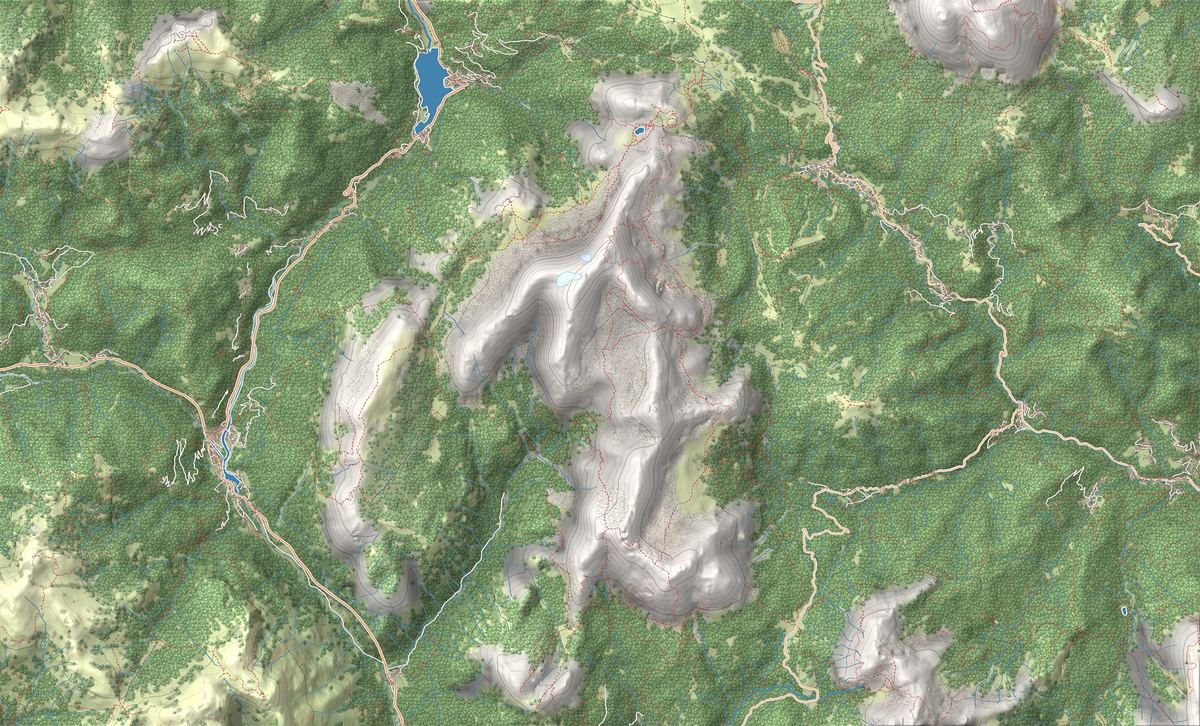
- 1Lago di Coldai and Rifugio Coldai on the Alta Via 1
- 2Rifugio Tissi: the balcony facing the Civetta wall
- 3Rifugio Coldai
- 4Rifugio Tissi
- 5Parete nord-ovest del Monte Civetta
- 6Lago di Coldai sull'Alta Via 1
- 7Borghi e musei del gelato di Zoldo
The best-known peaks
- Monte Civetta3,220 m
- Piccola Civetta3,121 m
- Cima de Toni3,169 m
- Punta Tissi3,061 m
Elevations from the map (OpenStreetMap).
How it is built: the face and the glaciers
The Dolomites UNESCO Foundation explains that the Civetta-Moiazza group has kept younger rocks, from the Upper Triassic and Lower Jurassic, which erosion has stripped from the nearby Pale di San Martino. Carved into those regular beds are the vertical walls, the north face of Monte Civetta and the south face of the Moiazza, more than a thousand metres high.
Two small glaciers survive on the Civetta, the Cristallo and the Giazzer, which the Foundation describes as melting fast. The Cristallo is the hanging glacier in the middle of the north-west face.
How to get there
On the Zoldo side you start from Palafavera, on the road to Passo Staulanza, and climb to Rifugio Coldai and Lago di Coldai. On the Agordino side you start from Listolade and walk up Val Corpassa towards Rifugio Vazzoler; Rifugio Tissi, facing the wall, can also be reached from Alleghe. Further south, from Passo Duran, a gravel road leads to Rifugio Carestiato, below the Moiazza.
In July and August, the Val di Zoldo tourist board says, the Civetta ski area lifts also open, from Zoldo, Alleghe and Selva di Cadore. The base in Val di Zoldo is Forno di Zoldo.
Huts, the traverse and via ferratas
Below the face, the Coldai, Tissi and Vazzoler huts are the stages of the classic Civetta traverse, and Coldai is also a stage of the Alta Via 1. The full tour of the group takes at least two days. On the east side the Tivan path, partly protected, circles the rock at altitude.
Rifugio Torrani, at 2,984 metres, sits close to the summit. You reach it from the north-east by the Alleghesi via ferrata, from the south by the Tissi via ferrata and from the east by the normal route, the easiest of the three but still demanding. From the hut you carry on to the top.
The walls hold a great many climbing routes, many of them very hard, including on Torre Venezia and Torre Trieste above Rifugio Vazzoler: if you are just starting, read our climbing guide.
History: from Roman inscriptions to the sixth grade
On the northern slopes of the group there are inscriptions carved in the rock, FIN BEL IUL, which the scholar Ettore Ghislanzoni dates to the 1st-2nd century AD and which marked the boundary between the territory of Belluno and that of Iulium Carnicum. The best known is the Tapp de le Parole, north of Monte Coldai.
The name first appears in a document of 1665, as Zuita. The first to reach the summit, officially, was the Englishman Francis Fox Tuckett in 1867, with the Swiss guides Melchior and Jakob Anderegg; but the top had already been reached at least in 1855 by Simeone De Silvestro, known as Piovanel, a hunter from Pecol.
On 7 August 1925 the Germans Emil Solleder and Gustav Lettenbauer climbed the north-west face in a single day, without a bivouac, over more than 1,100 metres of rock. For the Italian Alpine Club their route became the benchmark for the sixth grade. On 4 and 5 August 1931 Emilio Comici and Giulio Benedetti, from Trieste, opened an even harder route on the same face.
Names and UNESCO World Heritage
The origin of the name is debated: some link it to the Latin civitas, because the face would resemble a city of towers, others to the little owl, civetta in Italian, since the mountain has the same name in Val di Zoldo, where the face cannot be seen. In German the group is the Civetta-Gruppe.
The Civetta and the Moiazza are part of system 3 of the Dolomites UNESCO site, Pale di San Martino, San Lucano, Dolomiti Bellunesi and Vette Feltrine: 31,666 hectares across the provinces of Belluno and Trento.
Trails in the group
 EE · Experienced hikers
 EE · Experienced hikers
Mountain huts
 2,135 m2,250 m
Things to see

Sight · Val di Zoldo e Civetta
Parete nord-ovest del Monte Civetta
The wall of walls: four kilometres of rock nearly 1,200 metres tall, a myth of Dolomitic mountaineering.

Sight · Val di Zoldo e Civetta
Lago di Coldai sull'Alta Via 1
An emerald lake at 2,143 metres beneath the Civetta, one of the most photographed stages of the Alta Via 1.

Sight · Val di Zoldo e Civetta
Borghi e musei del gelato di Zoldo
Timber-framed mountain hamlets and the surprising story of the Zoldo ice-cream makers who took their craft to the world.
Frequently asked questions
How high is Monte Civetta?
3,220 metres, according to the Val di Zoldo tourist board.
Why is the Civetta called the wall of walls?
That is the climbers' name for the north-west face, up to 1,200 metres high and climbed by historic routes such as the Solleder-Lettenbauer, the Philipp-Flamm and the Aste and Andrich routes. You face it from Alleghe and from Rifugio Tissi.
How do you get to Lago di Coldai?
From Palafavera, in Val di Zoldo, you climb to Rifugio Coldai; the lake is close by. The route is on the route page.
Can you climb to the top of Monte Civetta?
Yes, but it is not a hike: you go via Rifugio Torrani, at 2,984 metres, by one of the two via ferratas or by the normal route, which the Val di Zoldo tourist board calls demanding. You need experience and equipment.
Who first climbed Monte Civetta?
Officially the Englishman Francis Fox Tuckett, in 1867, with the guides Melchior and Jakob Anderegg. Simeone De Silvestro, a hunter from Pecol, had already got there at least in 1855.
Is the Civetta a UNESCO World Heritage Site?
Yes. The Dolomites UNESCO Foundation places the Civetta and the Moiazza in system 3, together with the Pale di San Martino, the Pale di San Lucano, the Belluno Dolomites and the Vette Feltrine.