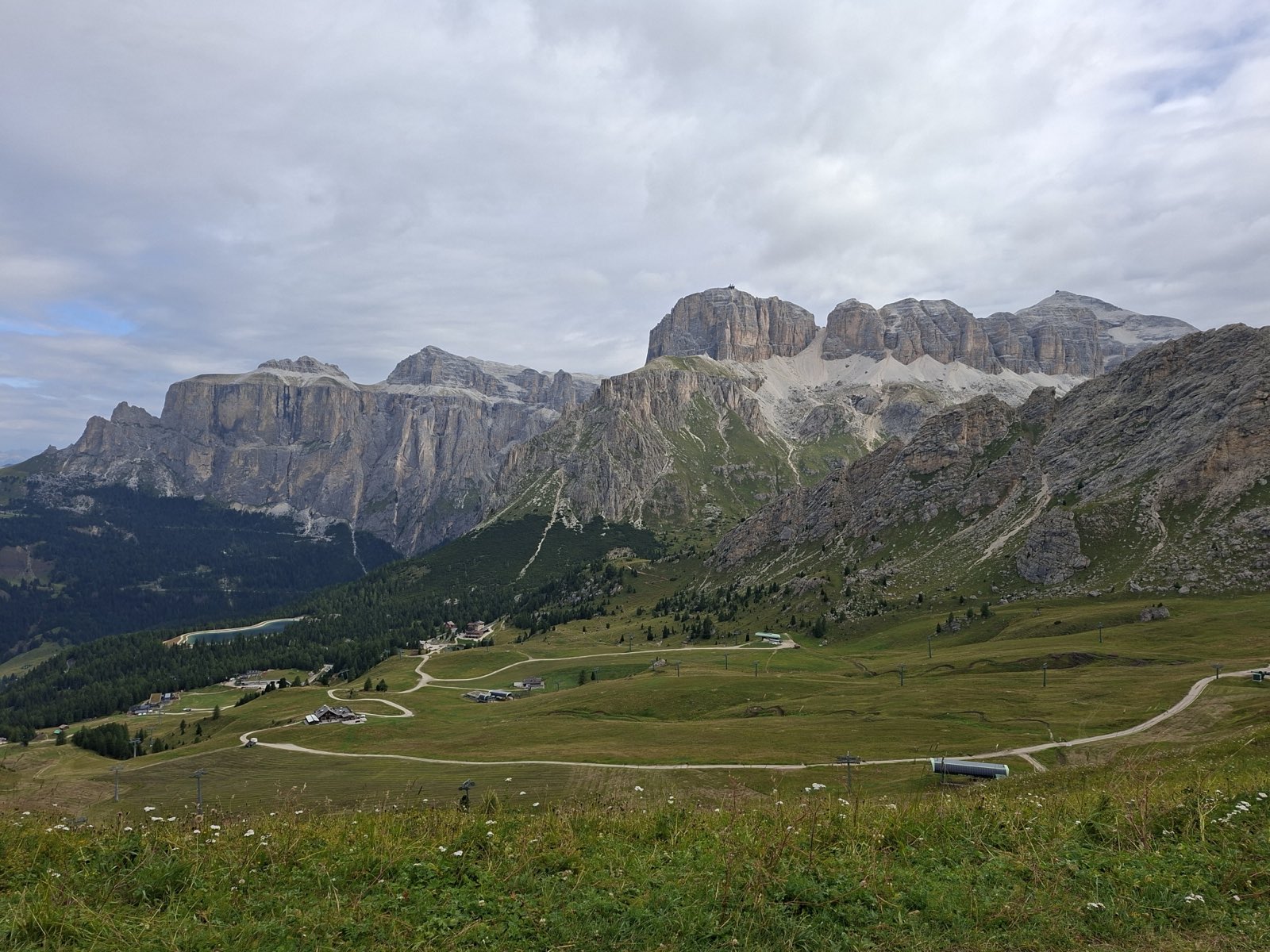
The Sella Ronda, written Sellaronda on the official maps and signs, is the ski tour around the Sella group. It crosses four passes, Gardena, Sella, Pordoi and Campolongo, and four Ladin valleys: Val Gardena, Alta Badia, Arabba and Val di Fassa. You complete it in a day, on pistes and lifts, without ever getting in the car.
The pistes are intermediate and each direction has its own colour. What catches out first-timers is the clock: the lifts close in the afternoon, and if you reach the last pass too late you can no longer get back to where you started.
Here you'll find the route in both directions, timing, where to start in each valley, the ski pass and the dates. The figures come from official sources, above all Dolomiti Superski, the ski pass consortium, which publishes the tour map. Where two official sources disagree, we say so. The wider picture is in our guide to skiing in the Dolomites.
The tour: four passes, four valleys, 44 kilometres
The Sella Ronda crosses the four passes around the Sella: Passo Gardena between Val Gardena and Alta Badia, Passo Campolongo between Alta Badia and Arabba, Passo Pordoi between Arabba and Val di Fassa, and Passo Sella between Val di Fassa and Val Gardena. It touches three provinces: Bolzano with Val Gardena and Alta Badia, Belluno with Arabba, and Trento with Val di Fassa.
According to Dolomiti Superski the tour is 44 kilometres long: 23 are skied and the rest is covered by lift. The Val Gardena tourist office gives the same figures. Alta Badia publishes different ones, 40 kilometres in all with 26 of piste, and elsewhere speaks of thirty. We use the Dolomiti Superski figures, since the consortium produces the official map.
Pass altitudes, from the same map: Passo Sella 2,244 m, Passo Pordoi 2,239 m, Passo Gardena 2,121 m, Passo Campolongo 1,875 m. The official sources do not publish a total vertical for the tour, and we don't estimate one.
Clockwise or anticlockwise: what really changes
You can ski the Sella Ronda in either direction, and each has its own colour: orange for clockwise, green for anticlockwise. Once you've chosen, follow that colour all day.
On the official Dolomiti Superski map the clockwise route lists 16 lifts, the anticlockwise one 18. That is the only measurable difference we found in the official sources: none of them says one direction is longer, harder or faster than the other, and the level required is the same.
Dolomiti Superski, in the English and German versions of its page, calls anticlockwise its favourite, without saying why. There is, however, a concrete reason to choose: the direction decides which pass comes last, the one you need to cross by 3:30 pm. You'll find it in the section on timing.
The order of the passes in each direction, starting from Corvara, according to the official map:
- Clockwise, orange signs: Corvara, Passo Campolongo, Arabba, Passo Pordoi, Val di Fassa, Passo Sella, Selva di Val Gardena, Passo Gardena, Colfosco, Corvara
- Anticlockwise, green signs: Corvara, Colfosco, Passo Gardena, Selva di Val Gardena, Passo Sella, Val di Fassa, Passo Pordoi, Arabba, Passo Campolongo, Corvara
How long it takes and when to set off
Dolomiti Superski and Alta Badia allow about six hours for the whole tour, the Val di Fassa tourist board five to six. Alta Badia breaks the time down like this: about two hours on the lifts, allowing for waiting times, and about an hour and a half of skiing downhill, depending on how you ski. The rest of the day goes on breaks and queues.
There are two rules. The first is to set off early: before 10 am for Dolomiti Superski and Alta Badia, by 10 am for Val Gardena, by 9:30 am for Val di Fassa. If you don't know the tour, go with the most cautious of these. The second is to cross the last pass by 3:30 pm, as Dolomiti Superski, Alta Badia and Val di Fassa all write.
The official sources don't list closing times for individual lifts: instead they give that 3:30 pm margin. The last pass is always the one that takes you back into your own valley, so it depends on where you start and which way you go:
- From Selva di Val Gardena: clockwise the last is Passo Sella, anticlockwise Passo Gardena
- From Corvara or Colfosco: clockwise the last is Passo Gardena, anticlockwise Passo Campolongo
- From Arabba: clockwise the last is Passo Campolongo, anticlockwise Passo Pordoi
- From Val di Fassa: clockwise the last is Passo Pordoi, anticlockwise Passo Sella
Where to start, valley by valley
You can join the tour from any of the four valleys: Val Gardena, Alta Badia, Arabba and Val di Fassa. The starting lifts below come from the official map and the valley websites; the number in brackets is the one you'll find on the map.
For the pistes and lifts of the ski area you start from, see our pages on Val Gardena and Alta Badia. The comparison of all the ski areas is in the guide to the Dolomites ski areas.
- Val Gardena: the tourist office names Selva as the ideal starting point. Clockwise, take the Dantercepies lift (30) towards Passo Gardena; anticlockwise, the Ciampinoi (29) towards Plan de Gralba and Passo Sella.
- Alta Badia: start from Corvara or Colfosco. From Corvara, clockwise take the Boè (19) towards Passo Campolongo; anticlockwise, the Borest (34) towards Colfosco and Passo Gardena.
- Arabba: the tour passes through the village, between Passo Campolongo and Passo Pordoi. In both directions the map shows the Arabba Fly lift (8) here.
- Val di Fassa: according to the tourist board you join from Canazei or Alba di Canazei by going up to Col dei Rossi, from Campitello by going up to Col Rodella, or from Pozza through the Buffaure and Ciampac areas, on a longer route.
The ski pass and season dates
For the Sella Ronda you need the Dolomiti Superski pass, because the tour crosses several ski areas. A pass for a single ski area is not enough: in its FAQ Dolomiti Superski explains that such a pass is valid only in that area, while tours like the Sella Ronda need the pass for the whole network.
If you hold a season pass for a single ski area, Dolomiti Superski offers four days valid across the whole network. You won't find prices here: they depend on dates, number of days and age, and should be checked on the official website when you buy. How the pass works and how to spend less is in our guide to the Dolomiti Superski pass.
The dates. The Val di Fassa tourist board lists the Sella Ronda as open from 4 December 2026 to 4 April 2027. Dolomiti Superski, as of 16 September 2026, still shows last season's dates, from 4 December 2025 to 7 April 2026. The consortium also warns that it cannot guarantee all pistes and lifts will stay open without interruption until the official end of the season.
Weather, closures and a missed last lift
In strong wind or heavy snow, gondolas and chairlifts can close without warning: the Val di Fassa tourist board says so, and Alta Badia adds that you should check which lifts are open before setting off. Dolomiti Superski shows on its ski tours page whether the Sella Ronda is open or closed, direction by direction, with service notices. The same status appears on the Val di Fassa website.
Before you set off you have three official tools: that page, the My Dolomiti Winter app, which shows open pistes and lifts, weather and webcams, and the PDF map of the tour, with the lifts for both directions. The lift numbers in this guide come from that map.
If you cross the last pass too late, you risk missing the lifts you need to get back to your starting point: that is Alta Badia's warning. You end up in another valley. None of the official sources we read mentions a return service for anyone in this situation, and getting back is up to you. That is why the 3:30 pm limit is worth taking seriously.
The longer tour, and the Sella Ronda in summer
The network has a second official tour, the First World War Ski Tour (Giro della Grande Guerra): about 80 kilometres around Col di Lana, six to eight hours, which Dolomiti Superski recommends only for fit skiers and which you can also join from Corvara and Arabba.
In summer the loop is done by road. For the car, see our timings for the four-pass loop. For bikes there is the Sellaronda Bike Day, the days when the four passes are closed to cars.
Frequently asked questions
How long is the Sella Ronda ski tour?
44 kilometres according to Dolomiti Superski, of which 23 are skied and the rest covered by lift. Alta Badia publishes different figures, 40 kilometres in all with 26 of piste. The tour crosses four passes: Gardena, Sella, Pordoi and Campolongo.
How long does the Sella Ronda take?
About six hours according to Dolomiti Superski and Alta Badia, five to six according to Val di Fassa. Alta Badia counts about two hours on lifts, allowing for waiting times, and an hour and a half of skiing: the rest is breaks and queues. Set off before 10 am, ideally by 9:30 am, and cross the last pass by 3:30 pm.
Is it better to ski the Sella Ronda clockwise or anticlockwise?
Clockwise is signed in orange, anticlockwise in green. On the official map the first lists 16 lifts, the second 18. Dolomiti Superski, on its English and German pages, calls anticlockwise its favourite, but no official source gives differences in length or difficulty. What matters more is which pass comes last, because you need to cross it by 3:30 pm.
What level do you need for the Sella Ronda?
Dolomiti Superski rates it as medium difficulty and says it takes a certain amount of stamina. Alta Badia considers it suitable for skiers of average experience in good physical condition. Beyond technique, endurance counts: it is about six hours with a timetable to keep.
Which ski pass do you need for the Sella Ronda?
The Dolomiti Superski pass, because the tour crosses several ski areas. A pass for a single ski area is not enough. If you hold a season pass for one ski area, Dolomiti Superski offers four days valid across the whole network.
Can you do the Sella Ronda with children?
The official sources give no minimum age and no shorter family route. The same conditions apply to everyone: intermediate pistes, about six hours of skiing, lifts and breaks, an early start and the last pass by 3:30 pm. Those are what to base the decision on.
What happens if you miss the last lift on the Sella Ronda?
You are left in a different valley from the one you started in, because the lifts you need to get back are closed. That is why Alta Badia recommends crossing the last pass by 3:30 pm. None of the official sources we read mentions a dedicated return service: getting back is up to you.
When is the Sella Ronda open in the 2026/27 season?
The Val di Fassa tourist board gives 4 December 2026 to 4 April 2027. Dolomiti Superski, in mid-September 2026, was still showing last season's dates, 4 December 2025 to 7 April 2026. In strong wind or heavy snow the lifts can close without warning: the tour's status, direction by direction, is on the Dolomiti Superski website.