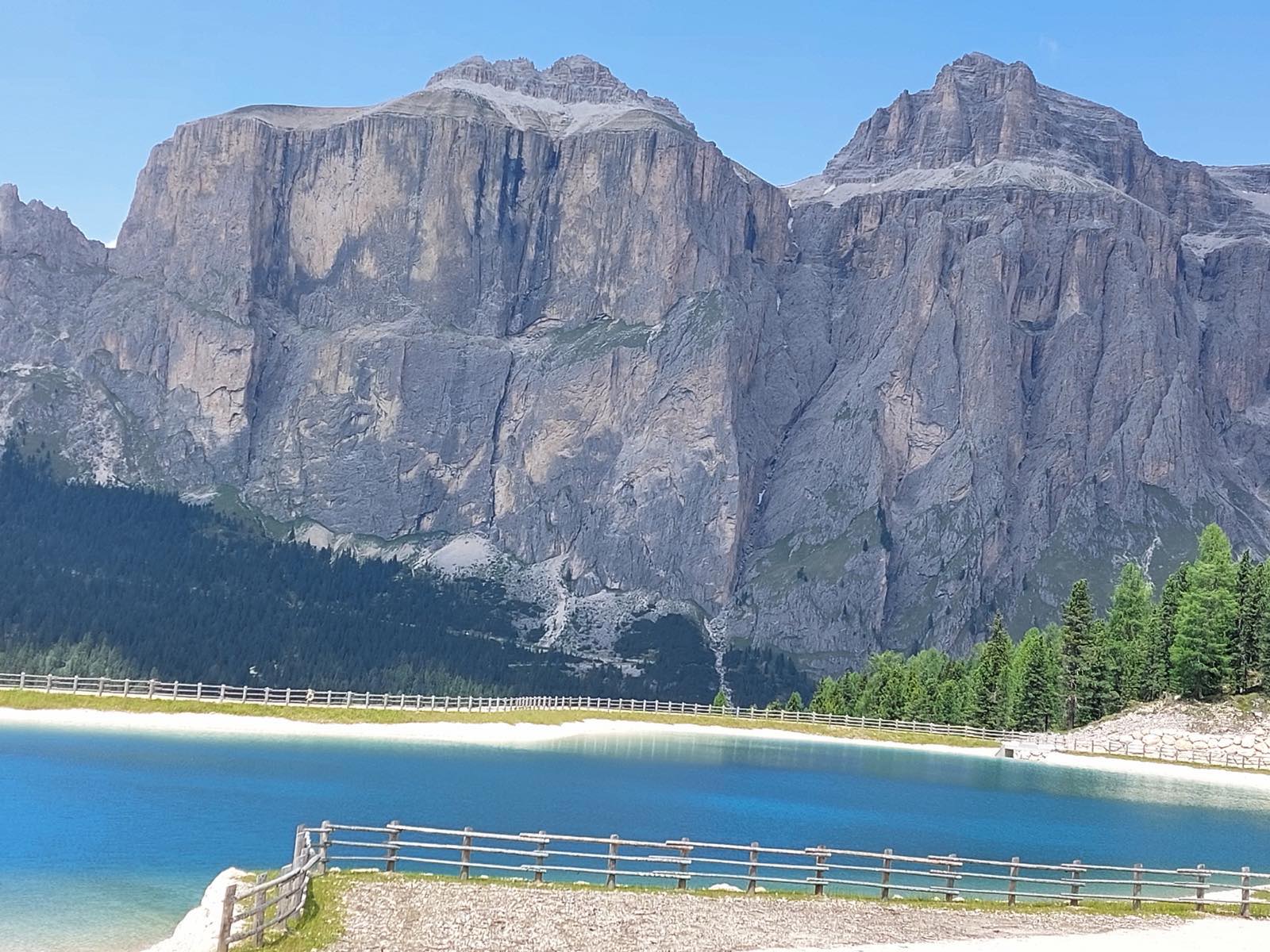
The Dolomites have a gift for hiding mirrors of water where you don't expect them. You round a bend, step out of a wood, and suddenly there's a turquoise in front of you that looks fake. These lakes are small, often cold, almost always set among the walls: you don't go to swim, you go to look.
They're not all alike. There's the one you reach two minutes from the car park, perfect for a walk with kids, and the one you only earn after hours on the trail. Some are packed by mid-morning, others stay silent. Knowing which one you're heading to changes the whole day.
This guide lines up the finest lakes: which are easy, which you earn on foot, how to get there and where to leave the car, and the question everyone asks, whether you can swim. To build a loop of water and waterfalls, start from the lakes and waterfalls section; to find your way among valleys and villages, from the localities. For the rest, read on.
The most beautiful lakes, one by one
If I had to name just one, it would probably be Lake Braies, in Val Pusteria: deep green water, the jetty and the wooden rowing boats, the Croda del Becco mirrored on the surface. It's the most photographed lake in the Dolomites, and it shows. Beautiful and very crowded, so there's only one rule: arrive at dawn or skip it.
For pure colour, Lake Sorapis is hard to beat: an unreal milky turquoise, above Cortina, that you only earn on foot. More convenient and just as striking are Lake Misurina, the Pearl of Cadore facing the Tre Cime, and Lake Carezza at the foot of the Latemar, the most fairy-tale of them all, its colours shifting with the light.
And then there are the less obvious ones: Lake Dobbiaco with its flat loop, Lake Coldai on the Alta Via 1 below the Civetta, Lake Santa Caterina near Auronzo, and the lakes of the Fanes plateau, in one of the wildest corners of the Dolomites.
- Lake Braies: the most famous, with the wooden boats
- Lake Sorapis: the most intense turquoise, on foot only
- Lake Misurina and Lake Carezza: scenic and easy to reach
- Dobbiaco, Coldai, Santa Caterina and Fanes: the quieter ones
Easy lakes, kids included
Several lakes can be walked around on a short, almost flat stroll, perfect for families. Lake Braies has a loop around the shore of just over three kilometres, on the level. Lake Dobbiaco has an easy, shaded circuit, doable with a stroller along much of the route.
Lake Misurina is also walked all the way round without effort, with the Tre Cime in the background, and Lake Carezza is visited on a short walk along the path that circles it. These are spots that please everyone: the little ones walk, the grown-ups take photos.
For more kid-friendly ideas, take a look at the itineraries for families and the guide to the Dolomites with kids.
Lakes you earn on foot
Some lakes have no car park below them: you get there only by walking, and that's exactly what makes them special. Lake Sorapis is reached from Passo Tre Croci on a demanding route, with a few exposed sections fitted with cables: it's no easy stroll, but the colour of the water pays back every step.
Lake Coldai sits along the Alta Via 1, at the foot of the great Civetta wall, and you earn it with a serious climb from the Val di Zoldo. The Fanes lakes, instead, reward anyone who ventures into a remote, silent plateau, far from the coaches.
These routes call for proper boots, water, and the usual caution with the weather: at altitude it turns fast. You'll find the practical detail in the trekking guide.
Can you swim in the lakes of the Dolomites?
It's the question everyone asks, and the short answer is: almost never. Most of these lakes are freezing even in August, sit in protected, fragile areas, as the Dolomites UNESCO Foundation points out, and swimming isn't allowed. At Lake Sorapis you stick to looking and taking photos from the permitted areas, without crossing the barriers. At Lake Carezza the shore is fenced precisely to protect it: you walk around it, you don't step in.
At Lake Braies diving in is forbidden, but you can rent one of the historic wooden rowing boats and sit out on the water, which is better anyway. On Lake Santa Caterina near Auronzo, an artificial reservoir, swimming is forbidden, and the same goes for Misurina: the municipal tourist office confirmed it to us. Where you really can swim is in our guide to swimming in the lakes.
In short: the lakes of the Dolomites are for your eyes and your feet, not your swimsuit. Bring a jacket instead: near the water, even in summer, the air is cool.
How to get there and where to park
In high season the sticking point is almost always parking. At Lake Braies car access is regulated in summer: in certain time slots you need to book the car park or take the shuttle, precisely because of the crowds. Check the current year's rules before setting off and, again, aim for dawn.
At Lake Carezza there are paid car parks along the Passo Costalunga road, with an underpass leading to the shore. Lake Misurina is easy to reach by car and has parking around it, while for Lake Sorapis you leave the car at Passo Tre Croci and carry on by foot.
As a rule, for the busier lakes it pays to arrive early: spaces fill up by mid-morning and in the middle of the day you risk the queue. For transport, shuttles and timing, the travel guide is useful.
When to go: seasons, light and autumn colour
High-altitude lakes are at their best in summer, from June to September, when the trails are clear and the water mirrors the sky. The best hours for photos are early morning, with soft light and still reflections, before the people and the wind arrive.
Autumn is an underrated season. At Lake Carezza and around Misurina the larches turn gold and the reflection on the water is worth the trip, with far fewer people. At the start and end of the season, though, watch out: some high trails may still hold snow or ice.
To pick the period based on what you're after, take a look at the guide on when to go to the Dolomites.
Beyond the lakes: waterfalls and springs
If you love water, the Dolomites don't end at the lakes. The Fanes waterfalls, hidden in the nature park, are among the finest in the Alps, and the walk to reach them is already a reward. Further east, the springs of the Piave at Sappada show where the river dear to Italy is born.
To put lakes, waterfalls and water walks into a single itinerary, the lakes and waterfalls section gathers all the options, filterable by area and difficulty.
Frequently asked questions
Which is the most beautiful lake in the Dolomites?
The most famous is Lake Braies, with its jetty and wooden boats. For sheer intensity of colour it's hard to beat Lake Sorapis, with its unreal turquoise, though you reach it only on foot. Among the most convenient and scenic are Lake Misurina facing the Tre Cime and Lake Carezza at the foot of the Latemar.
Can you swim in the lakes of the Dolomites?
Almost never. Most of the lakes are freezing even in summer, sit in protected areas, and swimming isn't allowed, as at Lake Sorapis or Lake Carezza, where the shore is fenced off. At Lake Braies swimming is forbidden but you can rent the wooden rowing boats. At Lake Santa Caterina and at Misurina swimming is forbidden, while at Lake Dobbiaco it is allowed but the water stays cold.
Which lakes in the Dolomites are good for children?
The easiest are Lake Braies, with its flat loop around the shore, Lake Dobbiaco, easy and partly doable with a stroller, and Lake Misurina and Lake Carezza, which you walk around on short strolls. None of them involve demanding climbs.
How do you get to Lake Braies and where do you park?
Lake Braies is in Val Pusteria. In high season car access is regulated: in certain time slots you need to book the car park or take the shuttle, to manage the crowds. The rules change every year, so it's worth checking before you set off, and arriving at dawn for both a space and better light.
What's the best time to visit the lakes?
Summer, from June to September, is the classic period, with clear trails and water that mirrors the peaks. For photos aim for early morning, when the light is soft and there's no wind. Autumn brings golden larches around lakes like Carezza and Misurina, with far fewer people.