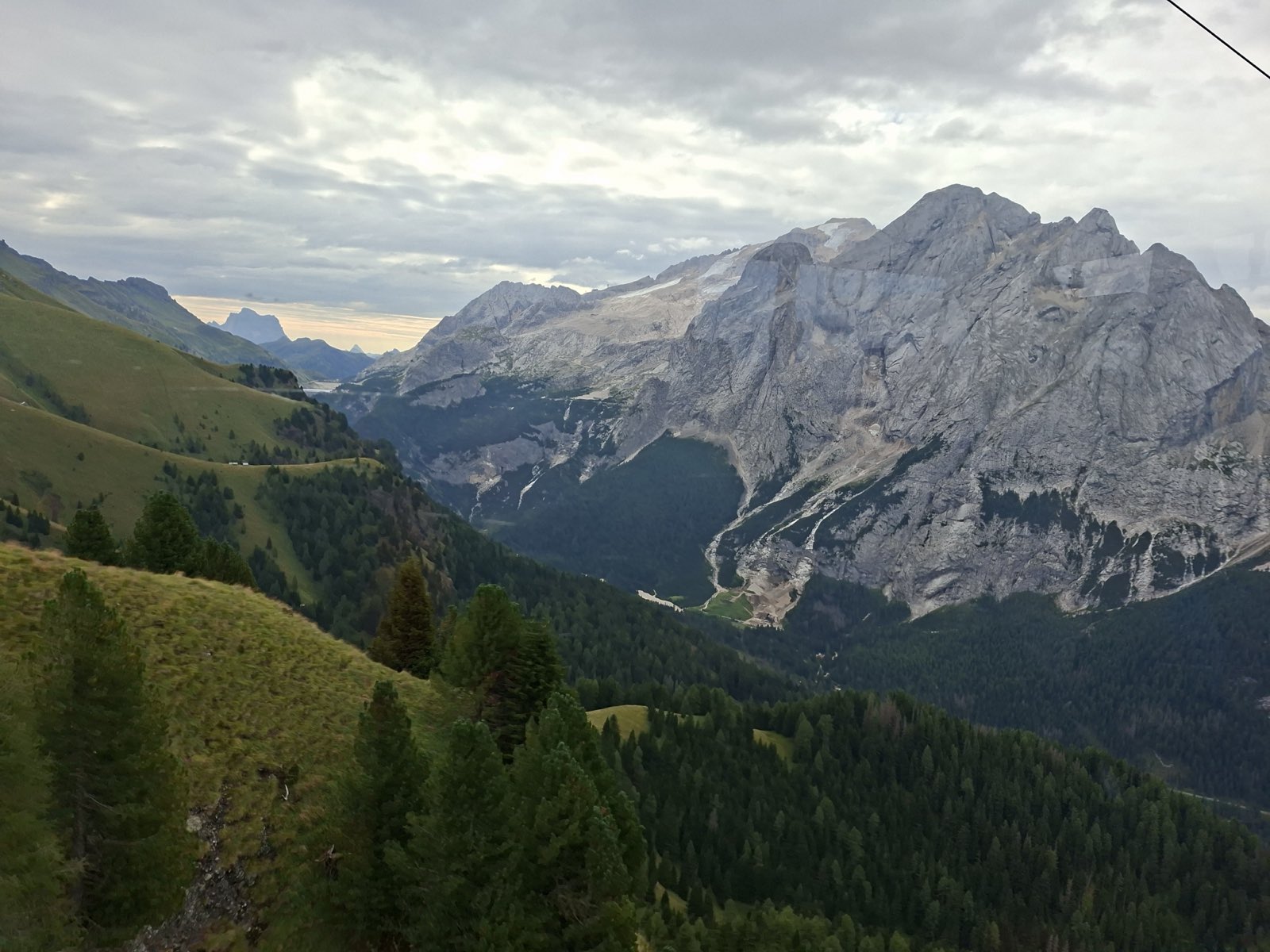
Arabba is a village at 1,602 m at the foot of the Sella, in the municipality of Livinallongo del Col di Lana. The lifts leave from the centre, and people use skis rather than the car to move around the village. The ski area has three sectors: Porta Vescovo above the village, Arabba-Plan Boè towards the Passo Campolongo, and Padon-Marmolada on the Malga Ciapela side, in the municipality of Rocca Pietore.
The Porta Vescovo side faces north and is often in shade: that is where the black runs are, the Fodoma first of all. On the far side of the Passo Fedaia the glacier cable car climbs to 3,265 m at Punta Rocca, the highest lift-served point in the Dolomites.
The 2026/27 season runs from 4 December 2026 to 18 April 2027: two weeks longer than the other zones of the consortium. The figures on this page come from official sources read on 7 October 2026.
Figures and altitudes
Dolomiti Superski counts 60 km of slopes and 23 lifts for the Arabba/Marmolada zone, and the Arabba tourist consortium gives the same figure ("over 60 km"). It is one of the smaller zones of the consortium, but with a vertical range no other one has.
Altitudes run from 1,450 m at Malga Ciapela, the valley station of the Marmolada cable car, to 3,265 m at Punta Rocca. On the way the cable car stops at Coston d'Antermoja (2,350 m) and Serauta (2,950 m), where the Marmolada Grande Guerra 3000 m museum is. The full ride takes 12 minutes. The Dolomiti Superski piste map gives slightly different figures (1,446 and 3,269 m): here we use the operator's.
On the Arabba side the village is at 1,602 m and the top of the Funifor, at Porta Vescovo, is at 2,478 m: that is where the Rifugio Gorza sits, with its terrace facing the glacier and the Sella.
- Arabba/Marmolada zone: 60 km of slopes, 23 lifts
- Lowest point: Malga Ciapela, 1,450 m. Highest: Punta Rocca, 3,265 m
- Porta Vescovo: 2,478 m, with the Rifugio Gorza
- 2026/27 season: 4 December 2026 to 18 April 2027
The three sectors
Porta Vescovo is the sector for experienced skiers: eleven slopes, north-facing, snow that holds into the afternoon. You go up from the centre of Arabba with the Funifor or with the gondolas to Pescoi and Porta Vescovo; higher up the Carpazza, Mesola, Antercrëp and Sass de la Vegla chairlifts and the Portados gondola do the work. This is where the Fodoma, the Sourasass, the Ornella with its black variant and the Salere start, the last of which is also the entrance to the Sellaronda.
Arabba-Plan Boè is the sunny sector and the easiest if you want quiet slopes: the Burz chairlift leaves from the village centre, the Arabba Fly links the two sides, and from Bec de Roces and the Passo Campolongo you head towards Alta Badia. The slopes are mostly easy and intermediate, except for the black Burz which drops straight to the village.
Padon-Marmolada is the detached sector. From Malga Ciapela a four-seat chairlift climbs to the Passo Padon; from there a slope runs along the walls of the Marmolada down to Capanna Bill and then through the Val d'Arei to the base of the glacier cable car. It is the link between the Marmolada and the Sellaronda and the main leg of the Great War ski tour. Last season this sector opened on 13 December, nine days after Arabba, and on 7 October 2026 the cable car had not yet published its dates: worth checking before you plan a day on the glacier.
- Porta Vescovo: Funifor Arabba-Porta Vescovo, Arabba-Pescoi, Pescoi-Porta Vescovo and Portados gondolas, Carpazza, Mesola, Antercrëp and Sass de la Vegla chairlifts
- Arabba-Plan Boè: Burz, Le Pale and Campolongo chairlifts, Arabba Fly link
- Padon-Marmolada: Padon chairlift from Malga Ciapela, practice drag lift, Malga Ciapela-Punta Rocca cable car
- Ski area hours: 8.30-16.00
The black runs
The Fodoma is the run Arabba builds its reputation on: 3.6 km, 804 m of vertical, a maximum gradient of 55% and an average of 29%. The operator calls it one of the hardest black runs in the whole of Dolomiti Superski. It starts with a 500 m wall all at 55%, then a gentler section, then the "lower Fodoma", a second steep stretch that reaches the village. You get there with the Portados gondola and the Carpazza chairlift, or with the Funifor.
The Sourasass follows a similar line but with longer and slightly less steep walls: 3.3 km, 749 m of vertical, 45% maximum. The Ornella variant is short and nasty: 592 m long, 221 m of vertical, 40% average and 53% maximum gradient, two walls one after the other. The Burz, on the other side, is 1 km long with 324 m of vertical and a wall at 58%: it was built in 1956 for American and Canadian athletes training for the Cortina Olympics.
Arabba is not only black runs, though. The Dolomiti Superski list counts 38 graded slopes in the zone: 17 easy, 16 intermediate, 5 difficult. The five difficult ones are Fodoma, Sourasass, the Ornella variant and Burz on the Arabba side, plus the Finau on the Marmolada side.
Sellaronda and the Great War ski tour
Arabba is one of the four entrances to the Sellaronda, 26 km of slopes around the Sella massif over the Pordoi, Sella, Gardena and Campolongo passes. Starting from Arabba the operator recommends clockwise, the orange signs: from Porta Vescovo you ski down the Salere and take the Alpenrose link, which leads to Pont de Vauz and the Passo Pordoi. Anticlockwise follows the green signs. You need the Dolomiti Superski pass; timing and advice are in our Sellaronda guide.
The other circuit is the Great War ski tour, which follows the Dolomite front of 1915-1917 with the Col di Lana at its centre, the mountain torn open by an Italian mine in 1916. The route passes the Sassongher, the Sella, the Marmolada, the Civetta, the Pelmo, the Cinque Torri, the Tofane, the Lagazuoi, the Conturines and the Settsass, among trenches, tunnels and gun positions. You ski it clockwise with purple signs or anticlockwise with red ones, and Dolomiti Superski opens it later than the Sellaronda: last season from 23 January to 22 March.
From Arabba you can reach Alta Badia on skis over the Passo Campolongo and Val di Fassa over the Passo Pordoi. A comparison of the zones of the consortium is in our guide to the ski areas.
Getting there and where to leave the car
From the south you come from Belluno through the Agordino, Alleghe and Caprile, then Livinallongo. From the north and west you come over the passes: from the Brenner motorway leave at Egna-Ora and drive up Fiemme and Fassa to the Passo Pordoi, or come via Ponte Gardena, Selva and the Passo Sella. From San Candido and Dobbiaco you drop down the SS51 and then the SS48. The nearest stations are Belluno (70 km), Brunico (50) and Bolzano (75).
In Arabba the lifts leave from the centre and accommodation sits a few metres from the two base stations: the operator describes it as a ski in / ski out village and suggests forgetting the car even to cross the village. A public car park list, with capacity or free spaces, is not published by the official sites: it is the thing most missing about this zone.
Malga Ciapela is a different matter: the Marmolada cable car has a large car park for cars and coaches a few steps from the base, open in summer and winter, with charging points for electric cars, and a campsite next door with facilities for caravans and campers. In winter that is where to leave the car if the day is on the glacier.
Ski pass, hours and obligations
The Arabba ski pass office is in the centre, at via Boè 13. For 2026/27 the published hours are: 13 to 26 November 2026 family pre-sale only, daily 15.00-18.00; closed on 27, 28, 29 and 30 November; from 1 December 2026 to 4 April 2027, Monday to Friday 8.00-12.00 and 15.00-18.00, Saturday and Sunday continuous 8.00-18.00. If you buy online you collect the card from the pick-up boxes in the village.
There is an Arabba-Marmolada valley pass and the Dolomiti Superski pass, which is the one you need for the Sellaronda and for the Great War tour. Prices are published by the consortium and by Dolomiti Superski and we do not repeat them here: the overview is in our Dolomiti Superski ski pass guide. Until 19 December 2026 the Dolomiti Super Première applies, with the 4=3 and 8=6 formulas.
Two obligations: a helmet, for everyone and at any age since the 2025/26 season, and third-party liability insurance, compulsory since 1 January 2022 and not included in the ski pass. If you bought the valley pass in past years, from 15 October 2026 you can use the measures accepted by the competition authority: details are on the refunds page. One practical note: the ski pass office hours stop on 4 April 2027, while the lifts of the zone are announced until 18 April.
Frequently asked questions
How many kilometres of slopes does the Arabba Marmolada ski area have?
Sixty kilometres of slopes and 23 lifts, according to the Dolomiti Superski table by ski area. The Arabba tourist consortium says "over 60 km". It is one of the smaller zones of the consortium but with the greatest vertical range: from 1,450 m at Malga Ciapela to 3,265 m at Punta Rocca.
When does the season end in Arabba?
On 18 April 2027, according to Dolomiti Superski: two weeks after almost all the other zones. The opening is 4 December 2026, the same day as the Sellaronda. The Porta Vescovo side faces north and the operator uses that as its argument for spring skiing.
What is the Fodoma like?
It is a black run of 3.6 km with 804 m of vertical, a maximum gradient of 55% and an average of 29%. It starts with a 500 m wall all at 55%, then there is a gentler section, then the "lower Fodoma", a second steep stretch down to Arabba. Funivie Arabba describes it as one of the hardest black runs in the whole of Dolomiti Superski.
Can I ski on the Marmolada glacier with the Arabba ski pass?
The Malga Ciapela-Punta Rocca cable car is part of the Arabba/Marmolada zone of Dolomiti Superski. Mind the dates: the Marmolada sector opens later than Arabba (last season on 13 December against 4 December) and on 7 October 2026 the cable car operator had not yet published its 2026/27 calendar.
Is Arabba suitable if you ski little?
Partly. Of the 38 graded slopes in the zone, 17 are easy and 16 intermediate, and they are concentrated on the sunny Arabba-Plan Boè side, towards the Passo Campolongo. The Porta Vescovo sector, on the other hand, is the one with the black runs and the gradients: better to know that before taking the Funifor up.
Which direction should I ski the Sellaronda from Arabba?
Funivie Arabba recommends clockwise, the orange signs: from Porta Vescovo you ski down the Salere and take the Alpenrose link towards Pont de Vauz and the Passo Pordoi. Anticlockwise follows the green signs. Either way you need the Dolomiti Superski pass.
Where can I park in Arabba and at Malga Ciapela?
At Malga Ciapela the Marmolada cable car has a large car park for cars and coaches a few steps from the base, open in winter too and with charging points. In Arabba, by contrast, the official sites do not publish a car park list: the lifts leave from the village centre and the operator relies on ski in / ski out.