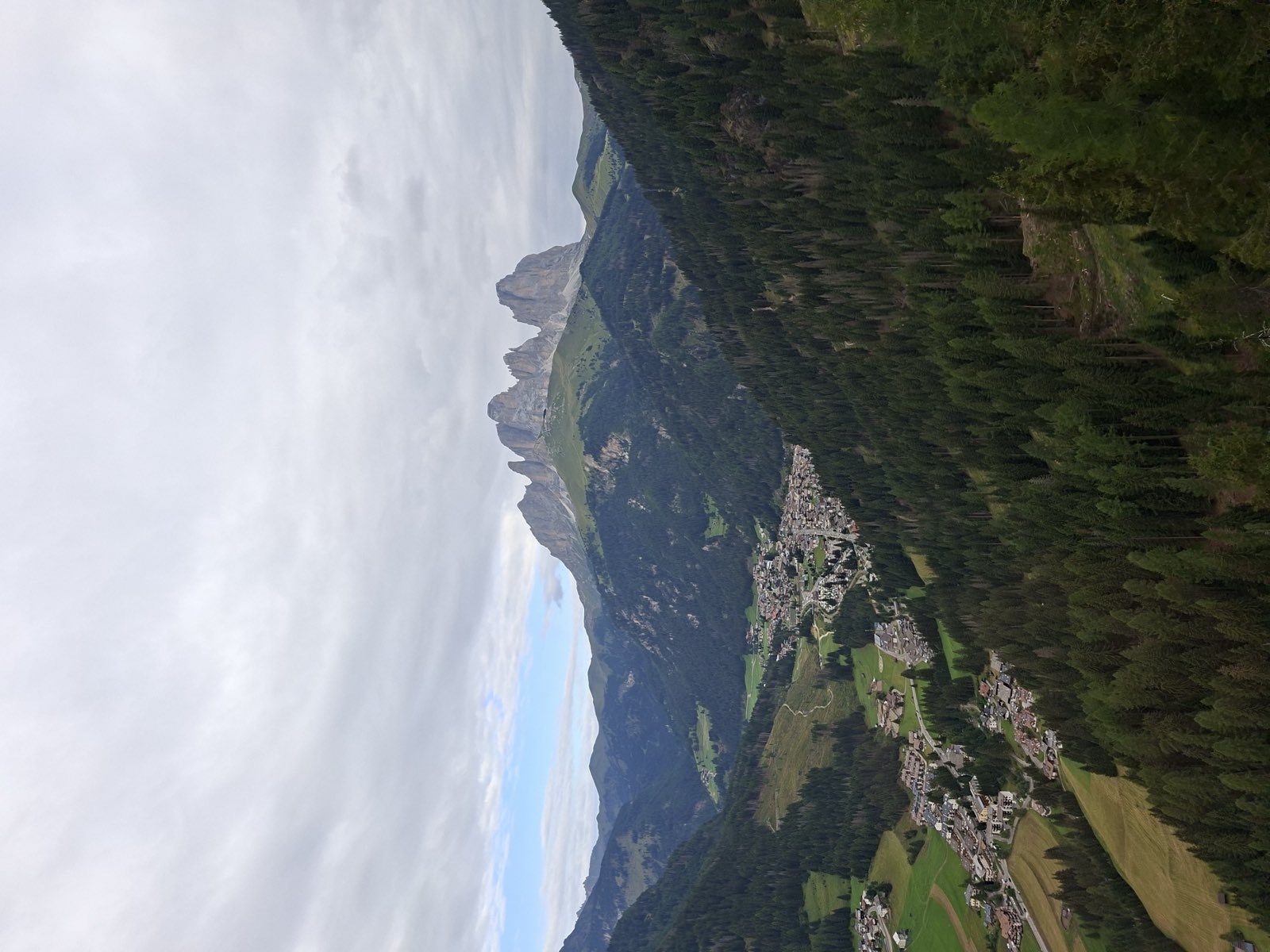
Val di Fassa is not one single ski area. It is a set of separate ski areas held together by the ski pass and the ski buses, and not always by the lifts. This page covers the three on the valley floor: Belvedere-Col Rodella above Canazei and Campitello, Buffaure-Ciampac between Pozza and Alba, and Catinaccio above Vigo and Pera.
The other three areas the tourist office lists under Val di Fassa are outside this page: Carezza has its own page, while Moena-Alpe Lusia and Passo San Pellegrino-Falcade belong to a different Dolomiti Superski zone.
The Sellaronda starts from Canazei and Campitello, and from the Ciampedìe you ski facing the Torri del Vajolet. The figures on this page come from official sources read on 7 October 2026; where they disagree, we say so.
Figures and altitudes
The tourist office publishes the numbers area by area. The three on this page add up to 68 km of slopes and 41 lifts: Belvedere-Col Rodella 31 km and 23 lifts, Buffaure-Ciampac 23 km and 12 lifts, Catinaccio 14 km and 6 lifts. The whole valley, counting all six areas, reaches 190 km and 77 lifts.
Watch how the Belvedere-Col Rodella count is built: the fassa.com list also includes the lifts at the Sella and Pordoi passes and the first sections on the Arabba side (Lezuo, Fodom, Maria). Those are the lifts you use for the Sellaronda, not slopes that stay in Val di Fassa.
Dolomiti Superski counts the zone differently: 49 lifts and 110 km for the whole Val di Fassa/Carezza area. Those figures are lower than the sum of the valley websites, and the consortium does not say what it leaves out. Altitudes run from 1,320 m at Pozza, the lowest valley station of the three areas, to 2,950 m at the Sass Pordoi, where the cable car from the Passo Pordoi arrives: there are no groomed runs from the top, the descents start lower down.
- Belvedere - Col Rodella (Canazei, Campitello): 31 km, 23 lifts, 30 slopes
- Buffaure - Ciampac (Pozza, Alba): 23 km, 12 lifts, 17 slopes
- Catinaccio (Vigo, Pera): 14 km, 6 lifts, 9 slopes
- Lowest point: Pozza di Fassa, 1,320 m. Highest: Sass Pordoi, 2,950 m
- 2026/27 season: 4 December 2026 to 4 April 2027, the same for all six areas
The three ski areas, one at a time
Belvedere-Col Rodella is the largest and the busiest. You go up from Canazei with the gondola to Pecol and from Campitello with the 3S cable car to the Col Rodella, at 2,480 m; the two sides meet at Pian Frataces. The slopes are wide and mostly intermediate, with long runs back to the villages. From the Passo Pordoi a cable car climbs to the Sass Pordoi, which works as a viewpoint and is included in the Lift & Walk ticket for non-skiers (55 euro for adults, 30 for those born after 2008, with a transfer from Pecol to the pass to be booked by 10.30).
Buffaure-Ciampac links two basins. From Pozza the gondola climbs to the Buffaure and from there, through the Val Jumela, you reach Sela Brunéch; over the saddle you drop into the Ciampac, the bowl above Alba sheltered by the Colac. At either end the black runs Vulcano and Ciampac-Alba take you straight back to the village. From Alba the cable car to the Col dei Rossi hooks the area onto the Belvedere, and it is the most direct way into the Sellaronda from this side of the valley.
Catinaccio is the most compact and the best suited to people who ski little: nine slopes, five of them easy. From the centre of Vigo a cable car climbs to the Ciampedìe, at 2,000 m, and from Pera you get there with the Vajolet chairlifts. The highest point is Pra Martin, where the Thöni starts and runs 4.5 km down to Vigo. At the Ciampedìe there is a Kinderpark and a practice slope served by a chairlift, kept apart from the main runs.
Difficulty, black runs and practice areas
In the five localities covered here, Dolomiti Superski lists 52 graded slopes: 13 easy, 32 intermediate, 7 difficult. This is an area for intermediate skiers, with few black runs but real ones.
The black runs are Il Muro and Diego on the Belvedere, Ciampac-Alba and the Sella Brunech variant on the Ciampac, Vulcano and Aloch at Pozza, and Alberto Tomba at Catinaccio. The Aloch is the Skistadium where the Italian team trains: the Pozza-Aloch chairlift only opens during the day for training, and last season the night opening of the slope was suspended. The Alberto Tomba is almost a kilometre reserved for expert skiers, named after the champion who trained in Val di Fassa for the World Cup.
The longest slope is the Buffaure Panorama, 5.1 km, rated intermediate. For first days on skis there is the practice area at the Ciampedìe, the carpets and the Buffaure di sotto chairlift at Pozza (with a beginners' day ticket limited to the gondola, the chairlift and the carpets), the Delle Baite practice slope at the Ciampac and the Family Park in Canazei.
Sellaronda and the other circuits
Val di Fassa is one of the four entrances to the Sellaronda: 26 km of slopes around the Sella massif, four passes (Pordoi, Sella, Gardena, Campolongo), four valleys and three provinces. You enter from the Belvedere by way of the Passo Pordoi, or from the Col Rodella towards the Passo Sella. Clockwise follows the orange signs, anticlockwise the green ones. You need the Dolomiti Superski pass; route, timing and the choice of direction are in our Sellaronda guide.
Dolomiti Superski offers two other circuits that touch this area: the Panorama Skitour, which links the Fassa ski areas to each other, and the Rosengarten Ronda on the Catinaccio side, towards Carezza. The consortium opens them later than the Sellaronda and closes them at the first strong wind: the zone page publishes live status, circuit by circuit and direction by direction.
From Alba you can also head for the Marmolada by way of Arabba and the Passo Fedaia. A comparison of the twelve zones of the consortium is in our guide to the Dolomites ski areas.
Getting there, parking and ski bus
From the south, leave the Brenner motorway at Egna-Ora and drive up the Val di Fiemme; from the north you come from Bolzano over the Passo di Costalunga, or from Ponte Gardena and the Passo Sella. In the valley the four villages covered here sit in a row on the main road, and each has its own base station.
The tourist office does not publish a car park list with capacities, but each ski area page carries a live table with the estimated wait at the lift, the wait at the ticket office and parking availability, lift by lift. On January and February weekends that is the thing to check before setting off.
The alternative to the car is the ski bus, a paid service running from December to the end of the ski season. The published fares (those of winter 2025/26) are 4 euro for one day, 10 for three, 20 for seven and 70 for the season; with the Val di Fassa Guest Card they drop to 2, 5, 9 and 30. Children up to 12, protected categories and dogs travel free. Reduced-fare tickets are sold at the tourist offices and by member accommodation; on board, at the stops and online you can only buy the full fare, and tickets are checked on board. The Guest Card is free for guests of accommodation that belongs to the tourist office.
Ski pass, helmet and insurance
The Val di Fassa day pass is valid on all the lifts of the Val di Fassa and Carezza consortium; only Vigo-Catinaccio and Carezza also offer a day pass limited to their own area. Morning and afternoon passes exist, but they are valid on a single pair of ski areas (Belvedere+Col Rodella, or Buffaure+Ciampac). To leave the valley you need the Dolomiti Superski pass, summarised in our ski pass guide.
A warning about prices: on 7 October 2026 the tariff document linked from the ski area pages was still the one for winter 2024/25. For up-to-date figures, look at the Dolomiti Superski price list or ask at the ticket offices. Each ski area is run by a different company with its own phone number: Belvedere, Col Rodella and Alba-Col dei Rossi together, then Ciampac, Buffaure and Vigo-Ciampedìe each on their own.
Two rules apply on every slope: a helmet, for everyone and at any age since the 2025/26 season, and third-party liability insurance, compulsory since 1 January 2022 and not included in the ski pass. If you bought valley passes in past years, see the page on the refunds agreed with the competition authority: the measures start on 15 October 2026 and concern people who bought the valley pass.
Frequently asked questions
How many kilometres of slopes does Val di Fassa have?
The three ski areas on the Fassa valley floor (Belvedere-Col Rodella, Buffaure-Ciampac, Catinaccio) add up to 68 km of slopes and 41 lifts according to the tourist office. Counting all six areas the valley lists, including Carezza, Moena-Alpe Lusia and San Pellegrino-Falcade, you reach 190 km and 77 lifts.
When does the 2026/27 season start in Val di Fassa?
From 4 December 2026 to 4 April 2027. The dates are the same for all six ski areas in the valley and match what Dolomiti Superski publishes for the Val di Fassa/Carezza zone and for the Sellaronda.
Where do you join the Sellaronda in Val di Fassa?
From the Belvedere, going up from Canazei and over the Passo Pordoi, or from the Col Rodella above Campitello, towards the Passo Sella. From Alba you reach the Belvedere with the cable car to the Col dei Rossi. In every case you need the Dolomiti Superski pass, not the valley one.
Are the Val di Fassa ski areas linked on skis?
Only partly. Buffaure and Ciampac are linked high up through the Val Jumela, and from the Ciampac you cross to the Belvedere with the Alba cable car. Catinaccio above Vigo, though, is not attached to the others: you get there by car or by ski bus.
Which are the black runs in Val di Fassa?
Seven, according to the Dolomiti Superski list: Il Muro and Diego on the Belvedere, Ciampac-Alba and the Sella Brunech variant on the Ciampac, Vulcano and Aloch at Pozza, Alberto Tomba at Catinaccio. The Aloch is the Skistadium where the Italian team trains and during the day it only opens for training.
Is Val di Fassa good for learning to ski?
Yes, if you choose where to go. The Catinaccio area has nine slopes, five of them easy, a practice slope served by a chairlift and the Kinderpark at the Ciampedìe. At Pozza the Buffaure has carpets and a beginner chairlift, with a dedicated day ticket. The Belvedere, by contrast, is mostly intermediate.
Where can I park to ski in Val di Fassa?
The tourist office does not publish a car park list with capacities, but each ski area page shows live parking availability and the estimated wait at lifts and ticket offices. The alternative is the ski bus, a paid service with reduced fares for Val di Fassa Guest Card holders.