
Cristallo is the mountain group between the Cortina basin, Misurina and the Val di Landro. Its main peak, Monte Cristallo, is 3,221 metres high. According to the Ampezzo Dolomites Nature Park the group has four peaks above 3,000 metres: besides Cristallo, the Cristallo di Mezzo, 3,154, Piz Popena, 3,152, and the Cristallino, 3,008.
The First World War front ran across the massif, and its remains can still be seen along the Ivano Dibona via ferrata, the best known in the group.
On the map
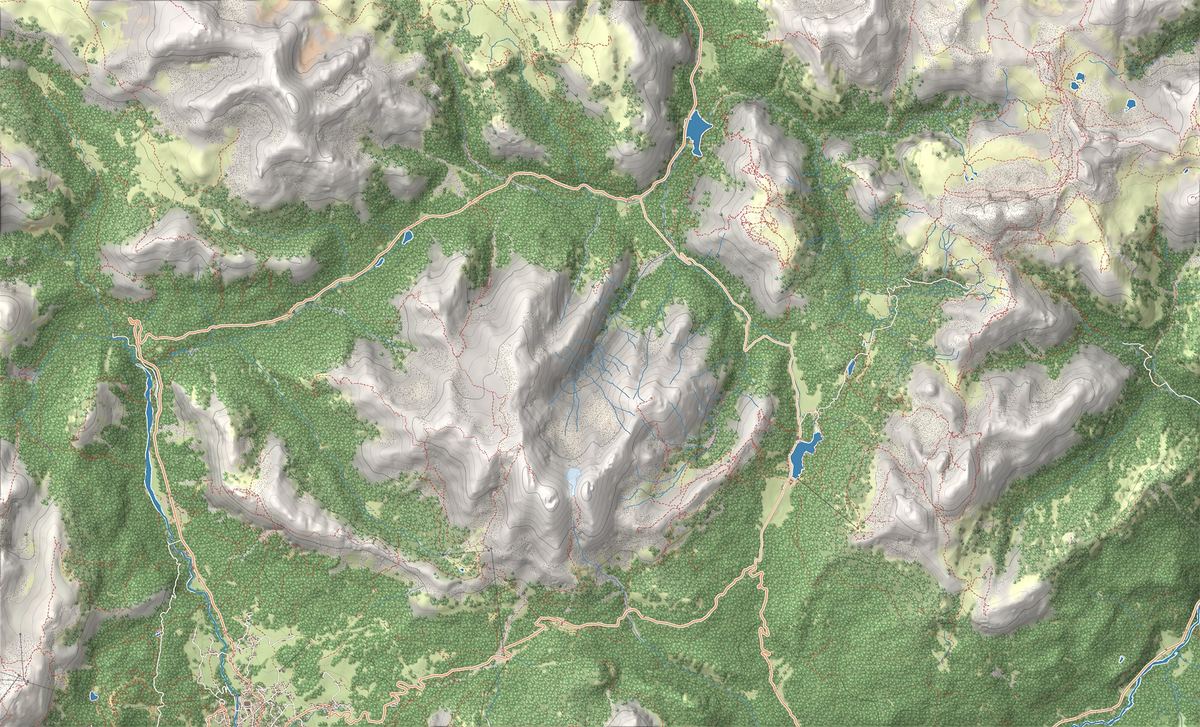
- 1Monte Piana: open-air museum of the Great War
- 2Monte Piana e il museo all'aperto della Grande Guerra
The best-known peaks
- Monte Cristallo3,221 m
- Piz Popena3,153 m
- Cristallo di Mezzo3,150 m
- Cristallino d'Ampezzo3,008 m
Elevations from the map (OpenStreetMap).
How the group is built
For the Dolomites UNESCO Foundation, Cristallo is one of the four areas of the Northern Dolomites system, and Val d'Ansiei separates it from the Cadini and the Sexten Dolomites. Its bastions of Dolomia Principale (Main Dolomite) have prism-like shapes that follow the fractures in the rock, and scree slopes and debris cones spread out at the foot of the walls.
The Ampezzo park describes the rock as heavily fractured and prone to collapse. The valleys on the north side, such as the upper Val Popena, are cut by faults, and summer storms send down debris flows. The same slopes are very prone to avalanches, and some high snowfields last through the summer. Towards Cortina, Val Padeon separates Cristallo from the Pomagagnon.
Where to see it from and how to get there
From Lago di Landro (Dürrensee), at 1,406 metres in the valley that climbs from Dobbiaco (Toblach), the view reaches as far as the Cristallo group, the 3 Zinnen Dolomites tourist board writes: it is the view in the photo above. Cristallo is also reflected in Lago di Misurina, and from Col de Varda, above Misurina, you see it together with the Sexten Dolomites and the Cadini.
The Cimabanche pass, at the head of the Val di Landro, sits on a plain formed where two alluvial fans meet, one coming down from Cristallo and one from the Croda Rossa, the Ampezzo park explains.
On the Cortina side, for the via ferratas, the tourist office points to Rio Gere, on the road to Passo Tre Croci, where there is a large car park, and to the chairlift up to Rifugio Son Forca: check the summer lift openings before you go.
The Ivano Dibona and Marino Bianchi via ferratas
The Ivano Dibona via ferrata crosses the whole group. Cortina's tourist office rates it for experts and reckons 9 hours, with 1,300 metres of ascent and 1,720 of descent. From Son Forca a steep scree slope, 900 metres of ascent, leads to Forcella Staunies, behind the historic Rifugio Lorenzi, now closed. Right after comes the Ponte Cristallo, a 30-metre suspension bridge. The traverse passes the Buffa di Perrero bivouac at Forcella Padeon, 2,760 metres, and descends towards Ospitale.
The Marino Bianchi via ferrata, also for experts, starts from the same saddle and follows the ridge to the summit of the Cristallo di Mezzo, 3,154 metres: 5 hours, 1,000 metres of ascent, back the same way. At that height, Cortina warns, you may find snow and ice. Gear and advice are in our via ferrata guide.
The First World War on Cristallo
Cristallo was on the Italian line. As early as May 1915 the Italians occupied the east, west and south ridges; the Austrians held the crests near the SS 51 road, the Forame, the Costabella chain and Monte Fumo (Rauchkofel), and dug trenches down to Monte Piana, Cortina's tourist office recounts.
Along the Dibona via ferrata you can see barracks, tunnels and bivouacs. The Buffa di Perrero bivouac is a barracks from 1915, restored in 2022 and named after Colonel Carlo Buffa di Perrero, who led the operations on that stretch of the front. Monte Forame, on the north-west side, holds many Austro-Hungarian remains but sees few visitors because it is hard to reach.
Just north of Misurina, Monte Piana is an open-air war museum, which the Auronzo and Misurina tourist board says can also be reached by shuttle.
Names, nature park and UNESCO World Heritage
In Italian it is Monte Cristallo or simply Cristallo. The 3 Zinnen Dolomites tourist board writes Cristallogruppe in German and Cristallo Group in English.
The Ampezzo side lies in the Ampezzo Dolomites Nature Park, together with the Tofana, the Cime di Fanes, Col Bechei and the Croda Rossa. The group is part of the Northern Dolomites, the largest of the nine systems of the UNESCO World Heritage Site, explained on our Dolomites UNESCO page.
Trails in the group
 E · Hiking
Things to see

Sight · Auronzo e Misurina
Monte Piana e il museo all'aperto della Grande Guerra
A plateau where around 14,000 soldiers died between 1915 and 1917, now an open-air museum with restored trenches, tunnels and walkways.
Nearby
Places that fall inside the group’s frame but are closer to another group.
- Versante nord delle Tre Cime di Lavaredo
- Cascate di Fanes
- Lago di Misurina
- Cadini di Misurina
- Tre Cime di Lavaredo Circuit: route, map and timings
- Cadini di Misurina to Rifugio Fonda Savio: among the most cinematic spires
- Fanes Waterfalls: the hike to the hidden cascades
- Lago di Misurina Circuit: an easy stroll at the foot of the Tre Cime
- Dobbiaco–Cortina Cycle Path: the great Dolomites railway trail
- Rifugio Auronzo
- Rifugio Locatelli
- Rifugio Fonda Savio
- Rifugio Bosi al Monte Piana
- Rifugio Città di Carpi
Frequently asked questions
How high is Monte Cristallo?
3,221 metres. The group has three more peaks above 3,000 metres: the Cristallo di Mezzo, 3,154, Piz Popena, 3,152, and the Cristallino, 3,008. These are the heights given by the Ampezzo Dolomites Nature Park.
What is the Ivano Dibona via ferrata like?
It is a traverse for experts: Cortina's tourist office reckons 9 hours, with 1,300 metres of ascent and 1,720 of descent. It starts at Rifugio Son Forca, climbs to Forcella Staunies and ends at Ospitale, crossing the 30-metre suspension bridge and passing the Buffa di Perrero bivouac.
Where do you park for the Cristallo via ferratas?
At Rio Gere, on the road from Cortina to Passo Tre Croci, where the tourist office indicates a large car park. From there the chairlift goes up to Rifugio Son Forca, the starting point of the Dibona and Marino Bianchi via ferratas.
Is there still a glacier on Cristallo?
Yes. The Ampezzo park counts it among the two Ampezzo glaciers where a mass of ice not covered by debris can still be recognised; most of it, however, lies in the territory of Auronzo.
Are there First World War remains on Cristallo?
Yes. The massif was on the Italian line, and along the Dibona via ferrata you can see barracks, tunnels and bivouacs. Monte Forame, on the north-west side, holds Austro-Hungarian remains.