
The Tofane are the three great mountains west of Cortina d'Ampezzo: Tofana di Rozes, Tofana di Mezzo and Tofana di Dentro. For the Ampezzo Dolomites Nature Park they are the highest peaks in the park, all above 3,200 metres. The highest is Tofana di Mezzo, 3,244 metres, where the Freccia nel Cielo cable car arrives.
You do not need a car to get high up, because the lifts leave from town. If you come from the Falzarego Pass, you face the great south wall of Tofana di Rozes. Peaks, huts and pages on this site are listed further down.
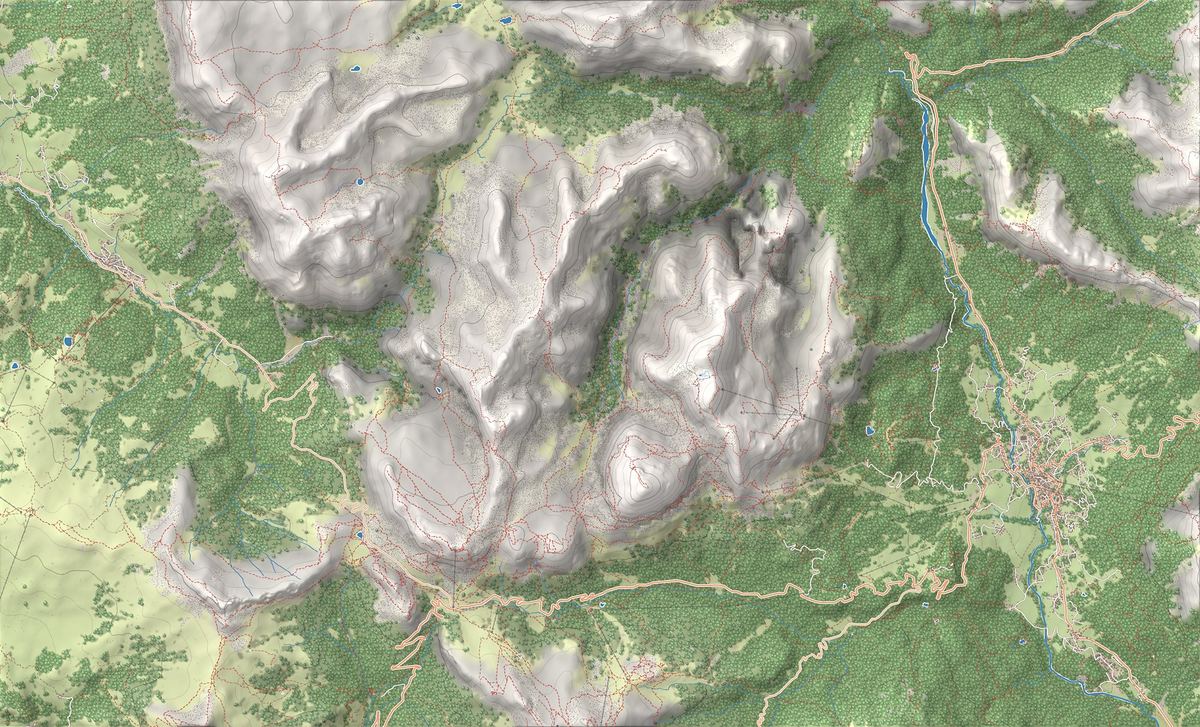
On the map
- 1Cinque Torri Loop: trekking among the Great War trenches
- 2Fanes Waterfalls: the hike to the hidden cascades
- 3Rock Climbing at the Cinque Torri: Cortina's classic crags
- 4Rifugio Lagazuoi
- 5Cinque Torri
- 6Rifugio Lagazuoi
- 7Tofane e Ra Valles
- 8Cascate di Fanes
- 9Passo Falzarego
The best-known peaks
- Tofana di Mezzo3,244 m
- Tofana di Dentro3,238 m
- Tofana di Rozes3,225 m
Elevations from the map (OpenStreetMap).
How the massif is built
The park describes the Tofane as one of the most massive mountains of the Ampezzo Dolomites. At the base lies a fragile band of red and grey clays; above it rise the walls of Dolomia Principale. Where the clays erode, the walls lose their support and collapse into the scree.
Three glacial cirques still hold snowfields. On the east side lies the Ra Valles basin, which ends in a sheer drop above Cortina to the south. To the north, Val Travenanzes, with no roads or huts, separates the massif from the Fanes Group. In the clays above Rifugio Dibona, Triassic amber has been found, among the oldest known in the world.
Going up
The Freccia nel Cielo leaves from Cortina, on Via dello Stadio, with a large car park next to the ice stadium. A gondola takes you to Col Drusciè, 1,778 metres, then two cable cars climb to Ra Valles and Cima Tofana. The operator puts the ride at 30 minutes. In summer 2026 the lifts run from 13 June to 27 September. What you see from Ra Valles is on our Tofane page.
The south side is reached by car: from the SS48 towards the Falzarego Pass, at the Fedarola junction, a road climbs to Rifugio Dibona, unpaved on the last stretch, with a large car park. From the Falzarego the cable car goes up to Rifugio Lagazuoi, facing Tofana di Rozes. Buses and hotels are on our Cortina page.
The via ferratas
The best known is the Lipella, on Tofana di Rozes. From Rifugio Dibona, trails 403 and 404 lead to the start, inside the Castelletto tunnel: 500 metres long with 120 metres of height gain, walked with a head torch. The ferrata reaches the fore-summit at 3,027 metres; the normal route leads to the top at 3,225, and you descend via Rifugio Giussani. Cortina's tourist site recommends it for experienced hikers: you may find snow and ice even in summer.
The others start from the lifts, and the Freccia nel Cielo operator lists them with via ferrata kit mandatory. Without a kit, it suggests the Talking Rocks trail (Sentiero delle Rocce Parlanti) from Ra Valles and the Rescue Permafrost trail up to Bus Tofana, at 2,770 metres. More routes are in our via ferrata guide.
- G. Aglio via ferrata, high difficulty: along the ridge to Cima Tofana, 3.5 hours, down by cable car
- Formenton via ferrata, medium difficulty: on the ridge between Tofana di Mezzo and Tofana di Dentro; as of 17 September 2026 the operator lists it as closed
- Olivieri-Punta Anna via ferrata, high difficulty: from Rifugio Pomedes to Punta Anna, 2,731 metres
- Olivieri protected path, low difficulty: from Pomedes to Ra Valles, 280 metres of ascent
The Great War
The front line ran across the Tofane. According to the park, the Forcella Col dei Bos area below Tofana di Rozes was a key sector: fortified boulders, trenches and the Castelletto mine tunnel remain, where the Italian mine was detonated on 11 July 1916 to take the Castelletto. On the ridge, the Formenton passes cavities dug by soldiers, and from Ra Valles the Ra Zestes trail follows the old communication trenches down. Facing the group, between the Lagazuoi and the Cinque Torri, lies the open-air museum.
Winter, names and UNESCO World Heritage
In winter the Tofane belong to the Tofana-Cinque Torri-Lagazuoi area, one of the two in the Cortina ski area. This is where you find the Olympia delle Tofane, the course of the 1956 Olympic downhills and of the women's alpine races in 2026, and the Skyline gondola links them to the Cinque Torri.
German and English sites also call them Tofane or Tofana. The Dolomites UNESCO Foundation places them in the Northern Dolomites, one of the nine World Heritage systems. The park that protects them was established by the Veneto Region in 1990, is run by the Regole d'Ampezzo and, on the highest ridges, points out an endemic plant, Saxifraga facchinii.
Trails in the group
 E · Hiking
 E · Hiking
 EEA · Via ferrata / Expert
Mountain huts
 2,752 m
Things to see

Sight · Cortina d'Ampezzo
Cinque Torri
A cluster of near-perfect rock towers above Cortina, a much-loved climbing spot and one of the finest open-air museums of the First World War.
Sight · Cortina d'Ampezzo
Rifugio Lagazuoi
The highest refuge near Cortina, with what many call the finest panoramic terrace in the Dolomites, and tunnels cut through the mountain during the Great War.

Sight · Cortina d'Ampezzo
Tofane e Ra Valles
The group that stands for Cortina: the historic Freccia nel Cielo lifts take you up in minutes to the bare amphitheatre of Ra Valles and Cima Tofana.
Sight · Cortina d'Ampezzo
Cascate di Fanes
Spectacular waterfalls tucked in a shaded forest gorge just north of Cortina, in the Ampezzo Dolomites Nature Park.
Passes
 2,105 m
Nearby
Places that fall inside the group’s frame but are closer to another group.
Frequently asked questions
How high is Tofana di Mezzo?
3,244 metres, according to the cable car operator: it is the highest of the three. Cortina's tourist site gives Tofana di Rozes as 3,225 metres, and the park says all three rise above 3,200.
Can you go up the Tofana by cable car?
Yes. The Freccia nel Cielo runs from Cortina to Cima Tofana in three sections and 30 minutes. In summer 2026 it runs from 13 June to 27 September.
Where do you park for the Lipella via ferrata?
At Rifugio Dibona, which has a large car park. You get there from the SS48 towards the Falzarego Pass, turning off at the Fedarola junction.
Which is the easiest via ferrata on the Tofane?
The Olivieri protected path, from Pomedes to Ra Valles, which the Freccia nel Cielo operator rates as low difficulty. The via ferrata kit is still mandatory.
What is the Castelletto tunnel?
The First World War mine tunnel below Tofana di Rozes, where the Italian mine was detonated on 11 July 1916 to take the Castelletto. Today it is the start of the Lipella via ferrata.